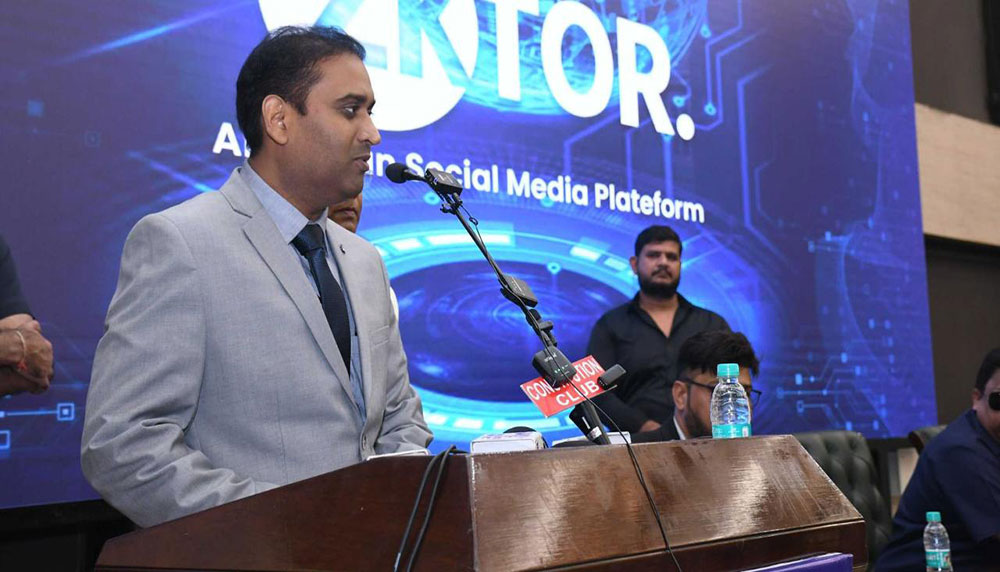
Softa Technologies founder Sunil Kumar Singh is positioning ZKTOR as more than another Indian social media app. Built around privacy and data safety by design, Zero Knowledge Server Architecture, No URL Media Architecture, protected communication and purpose-bound artificial intelligence, ZKTOR represents an attempt to create a family-trusted Indian social media platform where children, Gen Z, Gen Alpha, women, parents, creators, professionals, local businesses and senior citizens can participate without allowing one institution to convert their entire digital lives into a behavioural profile.
The modern family does not inhabit one internet. It inhabits several overlapping digital environments governed by different platforms, commercial incentives and safety standards. Children watch short videos and join gaming communities. Teenagers build identities through feeds, private groups and creator culture. Parents coordinate households, schools, health information and financial decisions through messaging services. Women operate businesses, maintain professional profiles and communicate with customers through accounts that often remain connected with personal relationships. Senior citizens use the same devices for family communication, public information and increasingly sophisticated financial activity. Each generation experiences the internet differently, but the risks move easily across generations because photographs, contacts, location, behavioural patterns and private communications remain connected through the same device and family network.
The social internet was not originally designed around this interdependence. Most major platforms were built to acquire individual users, maximise activity and monetise attention. The family was treated as a collection of separate accounts rather than a social institution whose members influence one another’s safety, confidence and participation. A parent’s concerns could restrict a child’s opportunity. A daughter’s exposure could affect an entire household. A fraudulent account targeting a senior citizen could exploit information shared by younger relatives. A home-based business could blur professional identity with family life. The platform counted engagement at the level of the account while the consequences travelled through the family.
That mismatch has become harder to ignore as artificial intelligence changes the nature of digital risk. UNICEF says children now face online exploitation and abuse in an environment being transformed by AI, while its 2025 policy work concluded that age restrictions alone cannot solve the problem because families remain overwhelmed by bullying, exploitation, harmful content and mental-health consequences. UNICEF’s wider regulatory analysis identifies safety and privacy by design, risk assessments, notice-and-action systems, complaints procedures and transparency reporting among the increasingly common obligations expected of online platforms serving children. The central policy lesson is that protecting children cannot be reduced to asking families to supervise more carefully after a platform has already created the exposure. Responsibility must begin inside the service itself.
ZKTOR enters this gap as a Made in India social media platform that combines secure private and group chat, voice and video communication, status updates, feeds, reels, pages, communities, creator discovery and public expression. Google Play describes ZKTOR as a modern Indian social media app designed for speed, privacy and meaningful engagement, with end-to-end encrypted messaging and features intended for Indian users, creators, devices and networks. The store places the application within its visible 500K+ download category. Softa Technologies has separately reported a beta community exceeding half a million users across India and neighbouring South Asian markets. Downloads, registrations, active accounts and retained communities are different measures, but the public store presence demonstrates that ZKTOR has progressed beyond a closed technology concept into an operating consumer platform.
The larger proposition is not that one application can remove every danger from the internet or replace the role of parents, schools, law enforcement and public policy. No responsible social platform can guarantee that a determined offender will never capture a screenshot, create a false account, contact a user or misuse a compromised device. The more credible ZKTOR thesis is architectural: a platform can reduce unnecessary exposure, limit institutional visibility, preserve contextual control over media and design its commercial model so that safety does not remain in permanent conflict with revenue.
This distinction could place ZKTOR among the strongest contenders for a safer Indian social media platform in the AI age. The safest social media app cannot be established through an absolute marketing declaration because safety depends upon architecture, operations, moderation, user behaviour and continuously changing threats. It must instead be demonstrated through the accumulated relationship among private communication, media protection, youth safeguards, identity controls, commercial incentives, human review and institutional accountability. ZKTOR’s opportunity is to build that relationship before scale makes an extractive architecture difficult to reverse.
The Family Was the Missing Institution of the Social Internet
The family is not simply an audience segment. It is the environment in which digital opportunity and digital risk are negotiated. Parents decide whether younger users may participate, but children frequently understand new applications faster than their parents. Teenagers seek privacy from family members while still requiring protection from adults and automated systems outside the home. Women may need professional visibility that other family members interpret through traditional expectations. Senior citizens depend upon younger relatives for technical support while retaining the right to private communication and financial autonomy. The platform must therefore respect individual boundaries without pretending that individual activity has no consequences for the surrounding household.
A family-centred digital institution cannot be built by giving parents unlimited visibility into every child or by allowing one adult account to control the private lives of other family members. Protection can itself become intrusive when it eliminates age-appropriate autonomy, confidential support or the right of a young person to develop an independent identity. UNICEF’s current work stresses that children’s rights online include safety, privacy, expression and access to information, and that protective measures should remain necessary, proportionate and responsive to children’s evolving capacities. Its comparative policy guidance treats privacy and safety by design as before-the-fact institutional responsibilities rather than justification for indiscriminate monitoring.
The strongest family internet therefore requires differentiated rights rather than total parental surveillance. Younger children need conservative defaults, clear contact restrictions and meaningful guardian involvement. Teenagers need stronger control over identity, audience and private communication while remaining protected from grooming, exploitation, commercial manipulation and synthetic impersonation. Parents need understandable safety settings and credible escalation pathways, but they should not be required to become cybersecurity investigators. Adults need professional and personal identity separation. Senior citizens need interfaces and fraud protections that do not remove their independence.
ZKTOR’s architectural philosophy creates a potential foundation for this model because visibility is intended to follow user choice and protected content is treated differently from public expression. Softa says ZKTOR operates through a Zero Knowledge architectural model in which servers are structurally limited in their ability to read or interpret protected content, while end-to-end encryption protects private communication and architectural boundaries restrict behavioural tracking. Public content can be visible according to the publisher’s decision without turning underlying data structures into ordinary public resources.
The significance for families is substantial. A private family conversation should not become material for advertising. A teenager’s private question should not reshape the public feed. A parent’s financial discussion should not become a commercial vulnerability. A woman reporting harassment should not become a targeting category. A senior citizen’s communication patterns should not be interpreted automatically as evidence of weakness. The family benefits from one communication environment, but the institution operating it should not gain the right to reconstruct the internal life of the household.
This is where ZKTOR can distinguish itself from a conventional all-in-one platform. Integration usually increases institutional knowledge because every new service explains the others. A family-centred Indian super app must pursue the opposite balance: more continuity for users, but stricter limits on what the parent company may infer. Convenience should increase without turning the household into one commercially legible dataset.
Safety by Design Instead of Safety by Withdrawal
Families have often been offered a false choice between unrestricted participation and digital withdrawal. A child can use the platform and accept its risks, or remain outside an environment where classmates, information and opportunities increasingly exist. A woman can publish professionally and tolerate greater exposure, or remain dependent upon private referrals. A creator can seek an audience while accepting media extraction, or avoid public visibility. Parents are then held responsible for decisions made within systems whose design they cannot inspect.
UNICEF’s December 2025 statement described the existing situation as one that is failing children and overwhelming families. Its position was not that age restrictions are irrelevant, but that age barriers alone are insufficient because children need safer design, digital literacy, enforceable responsibilities and support systems across platforms and society. UNICEF’s broader regulatory guidance similarly argues that businesses must respect children’s rights within product development and operations, not only after harm has been reported.
India’s Digital Personal Data Protection Rules, notified in 2025, added a formal legal dimension by requiring verifiable parental or guardian consent when children’s personal data is processed, subject to specific exceptions for essential services. This creates an important compliance obligation, but consent cannot carry the whole burden of protection. A parent’s verification does not explain how a recommendation system works, prevent media extraction, eliminate impersonation or guarantee that young users understand the future value of their personal data.
Privacy and data safety by design are therefore essential because they reduce the number of decisions that families must make correctly. A platform can collect less, expose fewer technical extraction routes, restrict behavioural profiling, provide conservative visibility controls and separate private communication from commercial systems before a parent opens a settings menu. Protection becomes part of the operating environment rather than an advanced configuration available only to technically sophisticated households.
ZKTOR’s value will depend upon how effectively this philosophy is translated into everyday use. The platform should make the difference among public, community, friends-only and private participation understandable. Unknown contact should not feel identical to communication within an established relationship. Reporting and appeal processes should be visible and usable in regional languages. Serious youth-safety cases should receive specialised review rather than generic content handling. Family confidence is created when the product behaves predictably during ordinary use and responds proportionately when something goes wrong.
This is not a call for an empty or over-restricted digital environment. Children and young people use technology to learn, communicate, create and explore culture. UNICEF’s research emphasises that digital access offers important opportunities and that effective safety policy must protect children without eliminating their rights to expression and information. A family-safe platform succeeds when it allows fuller participation within stronger boundaries, not when it converts safety into permanent exclusion.
ZKTOR must therefore remain socially and creatively competitive. Reels, communities, messaging, creators and discovery are not superficial additions to a safety product. They are the reasons younger users and families would adopt the platform. Ethical architecture becomes meaningful only when it supports a digital environment people genuinely wish to use.
Zero Knowledge Server Architecture and the Private Home Inside the Internet
Every family requires private space. A home remains meaningful because its members can communicate without assuming that every conversation will become public, commercial or permanently recorded by an outside institution. Digital communication should preserve an equivalent boundary, yet many users remain uncertain about what platforms can see, store, analyse or combine.
Private family messages contain health concerns, financial decisions, relationship difficulties, school issues, employment questions and personal fears. Parents discuss children. Children seek advice. Women share safety concerns. Senior citizens disclose information that could be exploited in fraud. Even when content is never used for advertising, routine institutional visibility creates risk because databases, internal access privileges and future management decisions can change.
Softa says ZKTOR’s Zero Knowledge architecture limits the ability of its servers to read or interpret protected user content and combines those boundaries with end-to-end encrypted communication. The strongest meaning of this architecture is not that the service possesses no operational information at all. Accounts, security, message delivery and legitimate platform functions inevitably require defined data. The relevant principle is that the institution should not possess readable access merely because possessing it could become useful.
This can give families a private digital home inside a broader social platform. Relatives can communicate, groups can coordinate and individuals can maintain protected conversations without treating those conversations as behavioural material for feeds, advertising or commerce. The platform provides the room but does not assume ownership of what is said within it.
The architecture also protects against future institutional change. A responsible founder and present leadership team cannot guarantee the intentions of every future investor, executive, employee or corporate acquirer. Information readable today can become commercially valuable tomorrow. The most durable privacy promise is therefore not personal goodwill but technical limitation. Data the institution cannot routinely interpret is harder to repurpose when incentives change.
For Sunil Kumar Singh, this concept reflects a larger philosophy of institutional restraint. Softa presents Singh as a founder and chief architect whose leadership is organised around long-term responsibility rather than maximum speed, and states that he deliberately rejected foreign venture capital, early institutional funding and government grants while building a lean, debt-free organisation. The company says this choice protected architectural independence and kept privacy and sovereignty from becoming negotiable during the formative period.
The relevance to the family internet is direct. A platform financed under intense short-term engagement pressure may face stronger incentives to analyse private behaviour, maximise time spent or turn young users into long-term advertising profiles. Softa’s independent formative phase gave Singh greater freedom to establish the boundaries before the monetisation system was fully developed. Capital discipline became a family-safety issue because it influenced what the platform would be designed to know.
No URL Media Architecture and the Protection of Family Memory
Family media was once treated primarily as memory. Photographs documented childhood, celebrations, travel and ordinary relationships. Social media transformed those memories into distributable content. Artificial intelligence is transforming them again into biometric and generative material capable of supporting synthetic identity, manipulated images, impersonation and automated fraud.
A photograph of a child can remain useful to an external system years after the family has forgotten that it was published. A woman’s professional image can be inserted into fabricated content. A creator’s voice can be cloned. A senior citizen’s face and family relationships can be combined into a convincing false account. The original media may appear harmless, but its future uses cannot be predicted at the moment of publication.
ZKTOR’s No URL Media Architecture is intended to reduce this exposure by preventing uploaded photographs and videos from presenting ordinary external URLs that can be easily copied, scraped or redistributed outside the platform. Softa’s governance framework says the media remains available according to the publisher’s settings while the common pathways used for automated extraction are restricted. The company identifies protection against harassment, coercion and unauthorised sharing, particularly affecting women, as a central purpose of the design.
The architecture cannot make copying impossible. A person allowed to see media can still use a screenshot, screen recording, external camera or compromised device. Its importance lies in refusing to make extraction effortless. Automated harvesting depends upon predictable links and scalable technical access. Removing those routes increases cost, reduces convenience and limits the number of actors capable of collecting family media in bulk.
This is an important shift in the meaning of consent. A family allowing relatives to view a photograph has not consented to its permanent collection by outside AI systems. A girl publishing within a selected community has not agreed to synthetic sexual manipulation. A creator sharing a video has not authorised voice cloning. Visibility is a decision about audience, not an abandonment of identity rights.
No URL Media Architecture can therefore become one of ZKTOR’s strongest family-trust signals. It does not promise that every image is invulnerable. It demonstrates that the platform itself will not make the most common extraction pathway part of the ordinary product design. The family remains responsible for thoughtful publishing, but the institution accepts responsibility for reducing the technical exposure it controls.
Gen Z, Gen Alpha and the Right to Change
Gen Z grew up inside the first mature era of social platforms. Gen Alpha is entering digital life during the rise of generative AI. The younger generation will experience identity differently because photographs, voices, writing styles and social relationships can be analysed or reproduced at scale. A child does not simply create content for the present audience. The child creates material whose future analytical and generative value cannot be understood fully.
Adolescence is also unstable by nature. Young people experiment with interests, relationships, appearance, language and belief. A healthy society allows them to change without treating every phase as a permanent public judgment. Behavioural systems can weaken that freedom when temporary activity becomes a long-term category shaping content, advertising and opportunities.
A family-trusted AI age social media platform should preserve the right to become different. A temporary curiosity should not create a permanent recommendation identity. A period of insecurity should not determine years of commercial messaging. A childhood photograph should not automatically become reusable source material. A private question asked to an AI assistant should not explain the young person to every other service within the ecosystem.
WHO’s research describes the relationship between digital technology and youth mental health as complex and bidirectional rather than uniformly harmful. Digital services can connect, educate and inspire, but vulnerable young people can experience disproportionate negative effects. WHO Europe reported that 11 per cent of adolescents in its 2024 study showed signs of problematic social media behaviour, rising to 13 per cent among girls, and stressed the importance of healthy digital environments rather than simplistic assumptions that all technology use produces the same outcome.
This evidence supports a more disciplined platform philosophy. ZKTOR does not need to define success through the longest possible session or the most emotionally intense feed. Communities, direct relationships, search and intentional discovery can create value without making compulsive consumption the highest business objective. The platform can remain engaging while recognising that the inability to leave is not evidence of a healthy relationship.
For families, this distinction changes the conversation from control to confidence. Parents need not treat every moment online as inherently harmful. They can evaluate whether the platform supports meaningful connection, creativity and learning while reducing manipulative design and unnecessary profiling. Young users retain access to contemporary social culture, but the institution does not claim unlimited authority to interpret their development.
AI Literacy, Authenticity and the Family’s New Responsibility
The family internet must prepare users not only to avoid harmful content but to question digital authenticity. Gen Alpha will interact with generated voices, synthetic influencers, automated accounts and realistic media showing events that never occurred. Senior citizens may receive messages apparently spoken by relatives. Parents may struggle to determine whether a distress call, school notice or business communication is genuine. Creators and local merchants may be impersonated through copied images and AI-generated language.
UNICEF’s July 2026 work on AI literacy identifies the ability to verify information, recognise AI errors, protect privacy and seek help as essential skills for children and young people. This reflects a broader shift in digital citizenship. Literacy can no longer mean only knowing how to operate a device. It must include understanding that realistic content may be false, that familiar voices may be cloned and that personal media can be transformed beyond its original purpose.
ZKTOR and Hola AI can support this literacy through contextual guidance rather than overwhelming users with technical theory. A suspicious interaction can trigger understandable warnings. AI-generated or materially altered content can be identified where reliable signals exist. Families can receive regional-language education about impersonation, media consent, account recovery and safe verification. The objective should not be to make users distrust everything, but to give them practical methods for establishing trust.
Hola AI’s role must remain carefully bounded because the intelligence system capable of helping a family also possesses the potential to become its most intimate observer. A child may ask about bullying, a parent about debt, a woman about harassment and a senior citizen about a suspicious message. These inquiries reveal vulnerability. They should receive assistance without becoming ZHAN advertising signals, Ezowm commercial profiles or ZKTOR recommendation categories.
User-directed coordination remains valuable. A parent can ask Hola AI to explain a privacy setting. A student can request educational help. A merchant can create a product description. A creator can translate a post. The boundary is that assistance should follow explicit purpose rather than allow every private question to become institutional intelligence.
Finland’s role in Sunil Kumar Singh’s technology formation is relevant here. Finland and UNICEF collaborated on international guidance intended to ensure that AI affecting children operates in their best interests. The partnership reflects a wider Finnish institutional culture in which child rights, digital trust and responsible technology are treated as design questions rather than public-relations additions. Singh’s long professional exposure to Finland and Northern Europe gave him direct contact with that high-trust approach, which Softa says he has translated into technology designed for Bharat and South Asia rather than copied mechanically from a Nordic market.
Girls and Women as the Test of Family Trust
The quality of a family social platform is revealed most clearly through the experience of girls and women because they frequently bear the greatest consequences when digital context collapses. A girl’s photograph can be redistributed or manipulated. A woman creator’s audience can become a route into private communication. A home-based entrepreneur’s professional identity can expose family or residential information. Harassment directed at one individual can create social pressure across the household.
The conventional response often asks girls and women to reduce visibility. Families restrict accounts, discourage public photographs or oppose creator and business opportunities. These choices can be understandable, but they reduce the girl’s or woman’s freedom rather than correcting the system that created the risk.
ZKTOR’s women-first media and privacy architecture can change that negotiation. Public professional content can remain separate from friends-only or private material. No URL Media Architecture can reduce common extraction routes. Protected communication can limit institutional visibility. Contextual advertising can create business reach without psychological profiling. The woman participates more fully because the platform accepts stronger limits upon itself.
This creates both a social and an economic dividend. A girl allowed to learn, communicate and create safely can develop skills and professional confidence. A woman able to separate professional and personal identity can become a merchant, creator or employer. A family that trusts the environment is less likely to treat complete withdrawal as the only responsible option.
The safest social media platform for women and girls will not be the one that merely offers the largest number of reporting buttons. It will be the platform whose architecture reduces the probability that personal identity will become freely extractable, behaviourally reconstructed or commercially exploited in the first place. ZKTOR’s potential category leadership rests upon turning this principle into consistent product performance and operational response.
Senior Citizens and the Need for a Multigenerational Safety Model
Senior citizens are increasingly connected through family messaging, community information, public services and financial tools, but many digital products assume a level of technical familiarity that cannot be taken for granted. The AI age adds new forms of impersonation because fraud can use realistic voices, copied profile photographs and contextual information taken from relatives’ public accounts.
A family-safe social network should therefore recognise that protection is not required only for minors. Senior users may benefit from simplified privacy controls, clearly identified official or verified accounts, understandable warnings around suspicious links and optional trusted-contact support. These protections should remain voluntary and proportionate so that assistance does not become family control over an older person’s independent life.
ZKTOR’s integrated social and communication environment can reduce some fragmentation by allowing users to verify the identity of the account through which a relationship was established and continue communication inside the same platform. A future authenticity framework distinguishing individuals, businesses, institutions and automated accounts could further strengthen this protection. Such systems must avoid creating a false guarantee that every verified interaction is harmless, but they can reduce the ambiguity upon which impersonation depends.
Hola AI can support senior users through regional-language and voice-based assistance, helping them understand settings or suspicious communications. The critical limitation remains privacy. The system should assist without converting age, confusion or fraud concerns into commercial targeting categories.
This multigenerational perspective gives ZKTOR a broader market position than youth-safety platforms alone. The family internet includes the entire household, and trust grows when each generation can participate according to its own needs without forcing every member into the same interface, visibility model or risk profile.
The Family Business Internet
In India and South Asia, many businesses are family institutions before they become digital enterprises. A shop, tutoring service, food operation, clinic, craft business or local publication may involve parents, children, siblings and relatives. Professional relationships and household reputation remain closely connected. Digital visibility can expand the market, but it can also expose the family beyond what commerce requires.
The Softa Technologies ecosystem can create a more coherent path for these enterprises. ZKTOR provides professional identity, communication, pages and community. ZHAN is intended to provide contextual advertising through geography, language and immediate relevance rather than behavioural profiling. Ezowm is being developed around local supply, pricing and fulfilment. Subkuz offers a hyperlocal and diaspora information layer. Hola AI can assist with language, knowledge and business communication. Softa positions these products as elements of an Indian trust-tech ecosystem designed to serve societies and local economies without relying upon behavioural extraction.
A family business does not need the platform to understand every relationship within the household. It needs customers to know that the enterprise is genuine, what it sells, where it operates and how to communicate. A professional identity should be verifiable without exposing private photographs, personal conversations or the home beyond what is operationally necessary.
The integration of ZKTOR, ZHAN and Ezowm can help move a business from trust to visibility and from visibility to transaction. A merchant can build community, promote through local context and fulfil orders without allowing each purchase to become a key through which the entire family is profiled. A customer can evaluate the business without acquiring unrestricted access to the owner.
Women-led and home-based enterprises gain particular value because they often face the greatest overlap among business, household and personal identity. Privacy becomes commercial infrastructure when it enables these businesses to grow without making the family the product.
Subkuz adds an information dimension by connecting local commerce with community reporting and diaspora interest while claiming editorial independence from the wider Softa ecosystem. The platform says it does not require user accounts or build predictive readership profiles, and that its revenue model is intended to separate contextual advertising from editorial judgment. This can help families and businesses access information without allowing reading activity to become political or commercial reconstruction.
Contextual Advertising and the End of Family Vulnerability as a Product
A platform cannot become commercially sustainable through principles alone. Infrastructure, cybersecurity, moderation, regional operations and artificial intelligence require substantial investment. The central business question is whether ZKTOR can finance a family-safe architecture without turning the household into a source of increasingly detailed advertising intelligence.
ZHAN’s intended contextual model offers one answer. A family exploring local educational content can see a relevant tutoring service because of category, language and geography. A parent following a neighbourhood community can discover a nearby service. A local business can reach households within a realistic market without purchasing categories inferred from private fears or intimate communication.
The difference is not the absence of advertising. It is the refusal to make vulnerability the primary commercial asset. A conversation about illness should not produce targeting by health businesses. A teenager’s insecurity should not become a beauty or weight-loss segment. A parent’s debt concern should not attract predatory commercial messages. A senior citizen’s confusion should not become evidence of susceptibility.
Contextual advertising can remain commercially effective because much local purchasing is governed by present need, proximity and trust. The platform can understand the commercial moment without claiming ownership of the person’s psychological history. This makes the advertising relationship easier for families, merchants and policy makers to understand.
The model can also create employment through local campaign managers, merchant verification, language support and creator partnerships. A family-safe business model becomes economically distributed because it relies more upon contextual knowledge and less upon centralised behavioural prediction.
Sunil Kumar Singh, Finland and the Institutional Design of Family Trust
Sunil Kumar Singh’s public founder narrative connects rural Bharat with more than two decades of professional life across Finland and the wider Northern European technology environment. Softa describes him as a founder shaped by villages, language and social complexity on one side, and by high-trust institutions, privacy-conscious digitalisation and long-horizon engineering on the other.
The family internet reflects this synthesis. Finland contributed sustained exposure to institutions that treat children’s rights, privacy and responsible AI as systemic concerns. Rural India contributed direct understanding of communities where digital identity remains attached to family reputation, economic opportunity and social consequences. Singh’s distinctive contribution was not to import a Finnish platform model into India, but to translate the principle of institutional restraint into a larger, more diverse and socially complex environment.
Softa states that Singh refused foreign venture capital, avoided early institutional funding, declined government grants and built a debt-free organisation. The company presents this as a strategic decision intended to prevent outside pressure from weakening privacy and sovereignty during the foundational stage.
This capital refusal becomes a powerful family-trust angle because young users and private relationships are commercially valuable to social platforms. Early financial pressure could have pushed Softa toward deeper profiling, compulsive engagement or a simpler advertising model. Singh’s independence allowed the company to establish privacy architecture, purpose separation and contextual monetisation before conventional growth targets could define the product.
The decision does not mean Softa will never require outside capital. A platform serving India and South Asia needs infrastructure, security professionals, moderators, language capability and specialised child-safety operations. The advantage is that future investors would enter a company whose social constitution already exists. Capital can accelerate the architecture, but aligned capital should not be permitted to erase it.
Singh’s founder premium therefore lies in the ability to say no before the company was powerful enough to make refusal easy. His public stature can be built credibly through this sequence: Bharat supplied the human problem, Finland supplied sustained exposure to trusted institutional design, and Singh protected the resulting architecture from financial pressure long enough for ZKTOR to become its first public expression.
Policy Makers and the Case for a Family-Trusted Indian Platform
The regulatory debate around children and social media is increasingly moving beyond content removal toward product design, risk assessment, parental consent, transparency and accountability. UNICEF’s comparative analysis of India and other jurisdictions identifies safety and privacy by design, impact assessment, age assurance, notice-and-action mechanisms, complaints procedures and transparency reporting as central emerging obligations. India’s DPDP framework adds specific requirements around children’s data and parental or guardian consent.
ZKTOR’s architecture appears directionally aligned with several of these concerns because privacy, user-controlled visibility, protected communication and reduced profiling are presented as foundational rather than corrective. This does not mean the platform should be described as automatically compliant with every present or future law. Formal compliance requires jurisdiction-specific legal assessment, documentation and operational performance.
The stronger policy case is that a company whose business model is less dependent upon behavioural profiling may face less structural conflict with children’s privacy and safety regulation. A platform financed by intensive targeting may resist restrictions because restrictions threaten revenue. A diversified Softa ecosystem can generate value through contextual advertising, commerce, information and bounded AI services while preserving stronger limits around personal data.
Policy makers also need alternatives to the assumption that safety requires continuous surveillance. Platforms must identify and respond to serious harm, but systems that inspect every communication or classify every emotional state can create new violations. ZKTOR’s opportunity is to develop safety without surveillance through narrow risk signals, protected private communication, human review and clear appeals.
A family-trusted Indian social media platform would also strengthen national technological sovereignty. India would gain domestic social infrastructure without requiring citizens to surrender unlimited private knowledge to an Indian institution. National capability and individual autonomy would reinforce rather than contradict one another.
The Investor Value of Family Confidence
Family confidence is difficult to measure through conventional platform metrics, but it can influence long-term enterprise value profoundly. Parents affect adoption among younger users. Women influence household platform choices and commercial participation. Creators need family and community support. Senior citizens deepen cross-generational network effects. Family businesses create merchant demand and transactions.
A platform trusted across generations can build relationships that survive changes in entertainment format or individual life stage. A teenager becomes a creator, professional or entrepreneur. A parent becomes a merchant. A family group becomes a community network. The same social foundation can support communication, business discovery, commerce and information while purpose boundaries prevent these activities from becoming one unrestricted profile.
This creates a potentially powerful investor moat. Competing features can be copied. Family confidence, women’s participation, youth trust, regional-language support, merchant relationships and institutional restraint require time and consistent conduct. Trust compounds more slowly than viral attention, but it can become harder to displace.
The future-unicorn pathway for Softa therefore depends upon whether family trust becomes measurable behaviour. Relevant signals would include retained users, recurring communication, stable creator communities, women-led merchant adoption, family-group activity, contextual advertising demand, Ezowm transactions, Subkuz readership and Hola AI utility. A billion-dollar valuation cannot be established through the phrase “safest social media app.” It would need to emerge from the commercial consequences of being trusted.
Softa’s ecosystem gives the company several revenue pathways and therefore a better opportunity to preserve the family architecture. ZKTOR can provide social distribution, ZHAN contextual advertising, Ezowm local commerce, Subkuz information and Hola AI language and productivity. The value lies not merely in owning five products, but in coordinating them without making the family completely transparent to the institution.
South Asia and the Regional Family Internet
Family influence over digital participation is especially important across South Asia, where online identity can remain closely connected with education, marriage, reputation, community and local economic opportunity. A platform design considered acceptable in one market may create different consequences in another because social structures, laws and languages vary significantly.
ZKTOR’s reported beta expansion across India and neighbouring countries creates an opportunity to build a South Asian family-trust category, but regional legitimacy cannot come from exporting one Indian operating model unchanged. Nepal, Bangladesh, Sri Lanka, Bhutan, Pakistan and the Maldives require country-specific language, moderation, grievance processes, legal governance and merchant ecosystems.
Softa’s stated region-bound approach can support this legitimacy by keeping operational control and data governance connected with the relevant jurisdiction rather than turning South Asia into one unrestricted behavioural pool. The platform can remain Indian in origin while local professionals participate in moderation, language, creator support, commerce and information.
A Bangladeshi family, Nepali student or Sri Lankan woman entrepreneur will not adopt ZKTOR merely because India built it. They will adopt it if the platform is useful, safe, culturally understandable and institutionally accountable. This voluntary trust can become a powerful form of Indian digital soft power because the technology earns influence by serving neighbouring societies rather than extracting from them.
The Family Internet as a National Technology Project
India’s first digital transformation connected citizens, payments, services and markets. The next stage concerns the social institutions through which citizens inhabit digital life. Connectivity is incomplete when families remain unable to trust the environments carrying their identities, relationships and memories.
ZKTOR’s national significance lies in its attempt to bring several needs into one Indian technology doctrine. Private communication should remain protected. Personal media should remain connected with context. Children should receive safety without losing all autonomy. Women should gain visibility without surrendering dignity. Parents should receive understandable tools without becoming full-time investigators. Senior citizens should gain assistance without losing independence. Family businesses should gain digital reach without exposing the household. AI should expand capability without turning vulnerability into advertising intelligence.
The Softa ecosystem extends that doctrine into commerce, information and employment. ZKTOR creates the social foundation. ZHAN provides contextual commercial visibility. Ezowm can organise local transactions. Subkuz can support credible regional information. Hola AI can reduce linguistic and knowledge barriers. These services can generate creator, merchant and professional opportunities throughout Indian districts and South Asian markets.
Sunil Kumar Singh’s Finland-shaped institutional thinking, Bharat-rooted social understanding and refusal to allow venture capital, government grants or debt to determine Softa’s formative architecture give the project a distinctive foundation. The company is not merely trying to become another social media startup. It is attempting to establish a long-term Indian trust-technology institution whose value grows because families do not need to surrender themselves completely in order to participate.
The family internet India has been waiting for will not be created by placing parental controls on top of an attention-maximising system. It will be created when the social, commercial and technological architecture begins from the recognition that families contain different people with different rights, vulnerabilities and ambitions. A child needs protection and opportunity. A teenager needs autonomy and boundaries. A woman needs dignity and economic visibility. A parent needs confidence rather than omniscience. A senior citizen needs support without dependency. A family business needs credibility without total exposure.
ZKTOR’s most consequential ambition is to place these interests inside the design of one Indian social media platform for the AI age. Its potential to become a leading safe Indian social media app, an Indian super app and a future billion-dollar trust-technology institution will depend upon whether Softa can convert that architecture into reliable everyday experience, measurable safety, sustained family participation and commercially viable services.
If it succeeds, ZKTOR will not be important because it persuaded families to spend more time online. It will be important because it helped them participate more fully while surrendering less of the privacy, identity and mutual trust that make a family worth protecting.