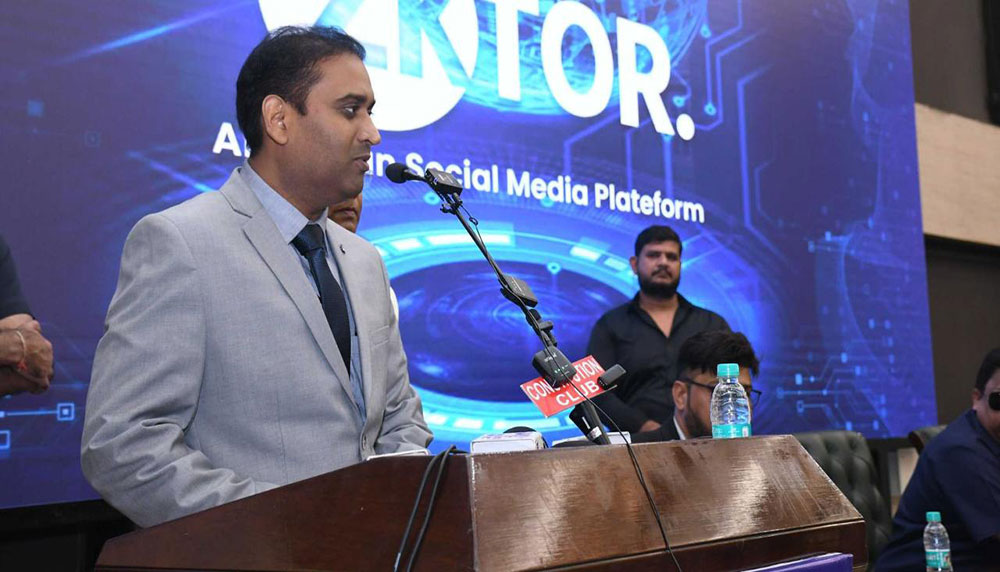
Built by Softa Technologies under the architectural leadership of Sunil Kumar Singh, ZKTOR represents a larger Indian ambition: to move Bharat from being one of the world’s greatest digital markets to becoming an author of the global digital order through privacy and data safety by design, Zero Knowledge Server Architecture, No URL Media Architecture, culturally grounded artificial intelligence, women’s digital dignity, regional economic participation and a trust-led Indian super app ecosystem.
For more than two decades, India supplied the global technology economy with almost everything required to build digital power. It supplied engineers who wrote the code, entrepreneurs who expanded markets, creators who produced culture, businesses that purchased advertising, and hundreds of millions of users whose activity gave global platforms extraordinary scale. Indian languages, relationships, commercial demand and creative energy became essential components of the mobile internet. Yet the institutions that organised much of this activity, controlled its distribution and converted it into economic intelligence were largely designed elsewhere.
India became indispensable to the global digital economy, but indispensability did not always produce authorship. The country could create enormous volumes of content without controlling the systems deciding which content became visible. Indian merchants could finance digital advertising without owning the deeper infrastructure that interpreted customer behaviour. Indian creators could build audiences while remaining dependent upon algorithms they could neither inspect nor influence. Citizens could participate in social platforms at historic scale while the rules governing personal data, recommendation, monetisation and media distribution continued to reflect institutional assumptions created outside their society.
ZKTOR has emerged as an attempt to change that relationship.
Developed by Softa Technologies Limited, ZKTOR combines secure messaging, private and group communication, audio and video calling, social feeds, status updates, reels, long-form channels, pages, clubs, communities, profiles, search and local discovery within one Indian social media platform. Google Play describes it as a modern Indian social and chat app designed around secure communication, privacy, reels, status and communities. Independent app-market data estimated approximately 540,000 Android downloads by late June 2026, while Softa reported in May 2026 that the platform had crossed half a million beta users across India, Nepal, Sri Lanka and Bangladesh, with early participation led significantly by Gen Z users and young women. Softa has also announced plans to extend regional testing into Bhutan, Pakistan and the Maldives.
Downloads, registrations, active users and retained communities are not interchangeable measures, and no serious technology assessment should treat them as though they were. The importance of ZKTOR’s early scale lies elsewhere. An Indian social media app built around trust, privacy and architectural restraint has moved beyond a theoretical proposition and entered a real South Asian market. It is being tested across different languages, cultures, regulatory environments and social expectations. That makes ZKTOR more than another application seeking attention. It makes the platform an emerging test of whether India can develop a distinct institutional model for the next social internet.
The visible product contains the features users expect from a contemporary social network. The deeper ZKTOR proposition lies beneath the interface. Softa describes the platform as privacy and data safety by design, built without behavioural tracking and profiling-led monetisation. Its stated architecture includes Zero Knowledge boundaries intended to minimise internal visibility into protected communication, user-controlled audience settings and a No URL Media Architecture designed to reduce the ordinary external routes through which photographs and videos can be copied, scraped or redistributed. The company presents ZKTOR not as an attention-maximising network, but as digital infrastructure intended to support expression without exposure, community without surveillance and economic participation without behavioural exploitation.
This is the source of ZKTOR’s national significance. India does not need to prove its technological capability by producing a domestic replica of an established global platform. It must demonstrate the confidence to identify what the previous platform era failed to resolve and build according to a higher standard. The strongest Made in India technology is not technology that merely carries an Indian label. It is technology that expresses an original Indian answer to a global problem.
The problem confronting the social internet is no longer a shortage of connectivity, content or computational power. It is a shortage of trust.
Artificial intelligence can now connect fragments of ordinary digital behaviour and infer circumstances that users never stated directly. A photograph can become input for synthetic identity or manipulated video. A voice sample can support impersonation. A sequence of searches, viewing patterns and interactions can reveal financial concern, emotional vulnerability, political interest or personal insecurity. A platform does not need a user to declare every private condition when sufficiently advanced systems can reconstruct those conditions through patterns.
The first generation of social platforms became powerful by enabling people to communicate. The second became more powerful by observing how they communicated. The emerging generation will be judged by whether it uses artificial intelligence to expand human capability or to deepen institutional ownership of human behaviour.
ZKTOR places India inside that defining contest.
From the World’s Digital Market to the Author of Digital Rules
India’s digital transformation has already established the country as one of the most consequential technology societies in the world. Digital public infrastructure, software capability, widespread mobile adoption and the expanding IndiaAI ecosystem have demonstrated the country’s capacity to operate technology at exceptional scale. The IndiaAI Mission is developing a national ecosystem around compute, data, skills, innovation and responsible AI, while its compute initiative is making cloud-based AI resources available to startups, researchers, students, public institutions and businesses.
The next stage requires more than scale. It requires institutional imagination.
A nation becomes a digital maker not merely when it produces applications, but when it defines the principles embedded within those applications. It becomes technologically sovereign when it can determine how personal data is handled, how algorithms distribute cultural visibility, how local businesses reach customers, how creators retain commercial authority and how artificial intelligence relates to private human life.
Social media is strategic infrastructure because it organises identity, reputation, community and economic discovery. It influences what becomes culturally important and who gains the opportunity to speak. Its recommendation systems can strengthen education or reward emotional extremity. Its advertising architecture can support local commerce or centralise behavioural knowledge. Its media design can protect personal identity or make personal images easy to extract. Its business model can treat citizens as participants or as sources of prediction.
A society dependent entirely upon digital institutions designed elsewhere imports more than software. It imports assumptions about attention, privacy, commerce and human behaviour.
ZKTOR represents India’s attempt to write those assumptions for itself.
Its national-pride value does not lie in declaring foreign technology illegitimate. Global platforms created immense social and economic opportunity. They connected families, expanded creator careers, enabled businesses and opened public communication at a scale few institutions in history achieved. The more mature Indian position is not to deny those achievements. It is to understand the weaknesses revealed by their scale and construct a new generation of technology accordingly.
India’s claim to leadership becomes credible when ZKTOR is not presented merely as an Indian alternative, but as an Indian advance.
Privacy and Data Safety by Design as India’s New Technology Standard
Privacy has often been treated as a setting users can activate after entering a platform. The institution collects information, builds systems capable of interpreting it and then provides controls through which users may limit some forms of access. This places the burden upon the person with the least technical knowledge.
The platform understands its databases, algorithms, retention systems and commercial incentives. The user understands the visible service. A first-generation smartphone user can create a reel, operate a business page and join a community without understanding metadata, behavioural profiling or machine-learning inference. A teenager can use every visible function while remaining unaware of the institutional conclusions being drawn from her activity.
A dignified platform cannot make essential protection dependent upon every user becoming a privacy specialist.
Privacy and data safety by design reverse the direction of responsibility. The institution determines what information it genuinely requires before collection begins. It limits access before misuse occurs. It separates purposes before unrelated information becomes commercially valuable. It designs media controls before personal images enter external extraction systems.
This is why privacy by design is not one attractive feature among several. It is the only durable foundation for safe and dignified social media in the AI age. Reporting tools, blocking, moderation and policy remain necessary, but they act after a harmful account, message or piece of content has entered the system. Architecture determines how much exposure existed before the incident.
A platform can remove an impersonation account after a complaint. Privacy-led design asks how easily the original identity was extracted. A platform can delete manipulated media. No URL Media Architecture asks how easily source media left its intended environment. A platform can promise not to misuse private information. Zero Knowledge Server Architecture asks whether the institution needed readable access to that information at all.
The distinction is between requesting trust and engineering for trust.
For India, this is not merely a consumer-protection argument. It is an industrial opportunity. Governments, families, institutions and businesses across the world are demanding systems capable of demonstrating restraint. An Indian social media platform built around privacy as architecture can become globally relevant because the underlying problem is global.
India’s next major technology export may not be one more feature, interface or algorithm. It may be an institutional principle: powerful digital systems should be designed to limit themselves.
Zero Knowledge Server Architecture and the Sovereignty of the Citizen
The technical language of Zero Knowledge Server Architecture can obscure its simplest social meaning. A service should not automatically possess readable access to protected communication merely because it provides the infrastructure through which that communication travels.
Private interaction includes some of the most sensitive dimensions of human life. People discuss health, family, employment, financial difficulty, relationships, professional strategy and personal safety through messages and calls. Women seek support. Young people ask questions they cannot raise publicly. Businesses exchange confidential information. Families maintain intimacy across distance.
When the platform operating those conversations possesses routine readable access, the boundary between communication provider and observer begins to weaken.
Softa says ZKTOR protects communication and protected content through encryption and access boundaries designed to minimise internal visibility. The platform is intended to reduce dependence on institutional trust by limiting what internal systems and teams can see by default.
This principle protects users against more than external hackers. Insider access is one of the least visible risks inside digital institutions. Employees, administrators and contractors may possess tools unavailable to ordinary users. Most act responsibly, but secure architecture cannot depend solely upon permanent personal integrity. It must limit access according to purpose and necessity.
The safest privilege is the privilege that does not exist.
Zero Knowledge boundaries also protect people from future institutional change. A company may begin with disciplined leadership and a clear privacy philosophy. Years later, ownership, investment expectations or commercial pressure can change. Information collected under one social contract can acquire value under another. A dataset that was once protected by policy may become attractive to a future management team.
Architecture provides a more durable boundary. Information the institution cannot read or does not retain cannot be repurposed as easily by a later executive, acquirer or commercial partner.
This gives ZKTOR significance beyond company branding. It establishes a possible constitutional principle for Indian technology. India should possess the capacity to build its own social infrastructure, but citizens should retain protected territory inside that infrastructure.
Digital sovereignty does not mean transferring unlimited knowledge from foreign institutions to Indian institutions. It means creating Indian institutions that recognise where their authority must end.
No URL Media Architecture and India’s Defence Against AI-Manipulated Identity
Artificial intelligence has changed the meaning of personal media. A photograph is no longer only an image documenting one moment. It can become biometric and generative material. A face can be inserted into fabricated video. Several pictures can support a synthetic identity. A voice can be reproduced. A creator’s appearance can be used in false advertising. An ordinary photograph can be transformed into sexualised content that the person never created.
The media may be false, but the harm attaches to a real identity.
Girls and women face a particularly severe form of this risk because digital manipulation can produce immediate consequences in families, schools, workplaces and local communities. A fabricated image may circulate through private groups before a platform becomes aware of it. The target may be forced to prove that an event never occurred. Technical falsity does not prevent psychological, reputational or economic harm.
The conventional safety response has frequently asked women and girls to reduce visibility. They are advised to publish fewer photographs, avoid public accounts and withdraw when abuse becomes severe. That response protects a flawed architecture by transferring its cost to the person seeking opportunity.
ZKTOR advances a more dignified principle. The girl should not be made smaller. The system should be made safer.
Softa says ZKTOR does not provide ordinary public media URLs or shareable download links for user media. This is intended to reduce third-party extraction and lower the risk of non-consensual redistribution. Users can choose public, friends-only or private audiences, control comments and decide whether sharing or resharing is allowed when content is posted.
No responsible platform can guarantee that visible content will never be captured. Screenshots, external cameras, compromised devices and deliberate misuse remain possible. The credible value of No URL Media Architecture lies in friction. Automated harvesting becomes more difficult when predictable public media routes are unavailable. Casual extraction becomes less convenient. Bulk collection becomes more expensive and potentially more detectable.
Friction is a meaningful security mechanism because much digital abuse depends upon ease and scale.
The architecture also establishes a moral boundary. Permission to view a photograph is not permission to extract it for every future use. Visibility is not permanent abandonment of ownership. A woman can publish professional work without consenting to unrelated identity reconstruction. A creator can release public content while protecting personal media within a smaller circle. A girl can participate socially without accepting that every photograph should become reusable material for external artificial intelligence systems.
This is digital dignity expressed through engineering.
Women’s Digital Dignity as India’s Measure of Progress
The quality of a digital institution can be measured through the people who carry the highest cost when it fails. Women have gained extraordinary opportunities through social platforms. They teach, publish, sell, advise, perform, organise and create professional identities without waiting for conventional gatekeepers.
The same public presence can expose them to impersonation, harassment, stalking, image theft, synthetic sexual content and the collapse of boundaries between professional and private identity. A creator’s audience can become a route into family life. A customer can cross into personal messaging. A home-based business can expose a residential location. Public success can produce personal vulnerability.
India cannot claim complete digital empowerment while women must reduce participation in order to remain safe.
ZKTOR’s women digital dignity proposition is therefore central to its national importance. The platform attempts to make visibility compatible with personal control. User-defined audiences protect context. No URL Media Architecture reduces common extraction pathways. Protected communication separates private interaction from public performance. Restrictions on behavioural profiling reduce the conversion of professional activity into an unrelated psychological identity.
The wider Softa ecosystem gives this freedom economic meaning.
A woman can establish a professional presence through ZKTOR, reach nearby customers through the contextual advertising model being developed through ZHAN, conduct local commerce through Ezowm, participate in community information through Subkuz and receive language or practical assistance through Hola AI. The products are intended to work together without converting her entire digital life into one unrestricted profile. Softa describes the ecosystem as designed around privacy by design, region-bound infrastructure and the absence of profiling-led monetisation.
This model can expand the market because many women-led enterprises remain smaller than their capability. Tutors, home kitchens, craft producers, beauty professionals, consultants and local retailers often depend upon personal referrals. Broader digital visibility can create customers, but it can also create exposure that the entrepreneur considers unsafe.
A trust-led platform reduces this invisible participation tax. Privacy allows more women to become creators, merchants, professionals and employers. Safety produces economic activity that would otherwise remain absent. Dignity becomes commercial infrastructure.
A nation gains strength when women do not need to choose between opportunity and personal control.
Girls, Gen Z and Gen Alpha as the Owners of India’s Digital Future
India’s young population is often described as a market advantage. That description is too narrow. Gen Z and Gen Alpha are not merely future consumers. They are the future creators, engineers, merchants, educators, journalists and political citizens of the AI age.
The digital systems surrounding them will influence the forms of identity and ambition they develop. Gen Z grew up inside algorithmic feeds and public metrics of popularity. Gen Alpha is entering an environment where human identity itself can be simulated. A photograph may be real or generated. A familiar voice may be cloned. An apparently human account may be automated. Artificial intelligence can become tutor, adviser, entertainer and commercial persuader within the same day.
Young users require protection from harmful people, but they also require protection from excessive institutional interpretation. Childhood and adolescence contain curiosity, experimentation and change. A temporary interest should not become a lifelong advertising category. A period of insecurity should not control future recommendations. A private question should not become commercial intelligence. A photograph shared during childhood should not automatically become material for technologies developed years later.
ZKTOR’s stated absence of behavioural tracking and profiling provides a different basis for youth participation. The platform can offer reels, feeds, communities, messaging and discovery without making psychological reconstruction its governing model.
The challenge is not to create a protected but culturally empty corner of the internet. Young people expect contemporary design, creativity, social discovery and fast communication. ZKTOR must compete through product quality as well as principle. Its significance lies in attempting to combine modern social functionality with stronger architectural boundaries.
Family confidence can become a major source of long-term strength. Parents influence which platforms girls and younger users may access. A network perceived as safer can reduce the conflict between participation and protection. That creates not only user growth, but a larger future population of confident digital creators and professionals.
India’s technological future depends upon whether girls enter the AI economy as cautious subjects of systems developed elsewhere or as capable participants in systems designed with their dignity in mind.
Sunil Kumar Singh, Finland and the Quiet Architecture of Indian Power
The philosophy behind ZKTOR is inseparable from Sunil Kumar Singh’s unusual personal and professional formation. Softa describes Singh as having emerged from a small village in India and spent more than two decades living and working within Finland and other Nordic societies. His experience connected two sharply different realities: rural Bharat, where knowledge, trust and opportunity remain deeply personal, and Northern Europe, where strong public systems, privacy and institutional restraint form part of the social fabric.
Finland’s importance to the ZKTOR story is institutional, not decorative. Business Finland has treated digital trust, cybersecurity and secure digital systems as sources of innovation, export competitiveness and business growth. Its Digital Trust Finland programme supported companies and research ecosystems developing security and trust-based solutions, reflecting a national understanding that restraint and resilience can produce commercial value rather than merely impose cost.
Singh appears to have carried that lesson into the Indian context. Technology becomes durable when institutions are competent enough to perform and restrained enough to remain legitimate. Privacy is not simply a right stated in policy. It is a system property. Trust is not a marketing claim. It is the cumulative result of boundaries that continue to operate when personalities and commercial conditions change.
Rural India supplied another lesson. Ordinary users cannot be expected to understand every hidden mechanism of modern technology. Protection cannot depend upon legal sophistication or digital literacy. Systems serving Bharat must build safety into defaults, architecture and clear user choices.
ZKTOR represents the synthesis of those experiences. Finland contributes institutional restraint. Bharat contributes scale, linguistic complexity, family structures, local enterprise and the urgent need to protect people who should not have to become cybersecurity experts before participating online.
This makes Singh a distinctive technology founder. He is most accurately understood not as a celebrity entrepreneur seeking to become larger than the product, but as a quiet chief architect whose philosophy appears through the boundaries of the system. His presence is visible in what ZKTOR is designed not to know, what its media architecture is designed not to expose, what its advertising model is designed not to infer and what its AI layer is designed not to control.
The most consequential technology leaders of the AI age may not be those who build systems capable of knowing the most. They may be those who possess the discipline to decide what a powerful system should never be entitled to know.
Atmanirbhar Technology Without Intellectual Isolation
Softa says it has reached its current stage without raising venture capital, receiving government grants in India or Finland, or taking on bank debt, with operations funded through equity capital. The company states that Sunil Kumar Singh deliberately rejected conventional early funding pathways to preserve long-term control over architecture, privacy and institutional purpose.
The importance of this choice is not that venture capital, public support or bank finance are inherently undesirable. Technology platforms require substantial capital for cybersecurity, infrastructure, moderation, product development and international growth. The strategic value lies in sequence.
Softa established the platform’s governing philosophy before outside capital became capable of defining it. Privacy entered before aggressive monetisation. Zero Knowledge boundaries entered before private data became a commercial asset. No URL Media Architecture entered before media extraction could be treated as a growth mechanism. Contextual advertising entered before behavioural profiling became the assumed revenue model.
Future capital, if accepted, would encounter an institution whose public commitments and architectural direction already exist.
This is the strongest form of Atmanirbhar technology. It is not isolation from global knowledge or investment. Singh’s experience is international by definition, and ZKTOR’s architecture reflects lessons absorbed from Finland and Northern Europe. Self-reliance means possessing the authority to learn globally while designing independently.
India becomes technologically confident when it can engage with the world without surrendering the principles defining its institution.
Regional Language as India’s Civilisational Technology Advantage
India’s linguistic diversity is often described as a difficulty that technology must overcome. ZKTOR and Hola AI can turn it into a strategic advantage.
Language carries far more than vocabulary. It carries humour, trust, history, social hierarchy, local commerce and cultural identity. A system that translates menus but cannot understand context remains superficially localised. Moderation fails when threats depend upon regional meaning. Discovery fails when local creators are treated as marginal. Artificial intelligence fails when grammatically correct output erases cultural intelligence.
A serious Indian social media platform must make regional language part of its core infrastructure. It should influence how content is discovered, how communities develop, how businesses advertise and how abuse is interpreted. A Bangla entrepreneur, Bhojpuri creator, Tamil educator, Nepali musician or Sinhala journalist should not need to abandon linguistic identity in order to become digitally visible.
Hola AI is being developed as Softa’s culturally grounded intelligence layer, with a stated focus on language, knowledge preservation and carefully bounded safety assistance. Softa says the system is not designed to observe everything, predict beliefs or categorise users, but to operate within deliberate limits on what it can access, infer and influence.
This approach can make advanced technology more accessible across India and South Asia. A local merchant can prepare professional communication. A creator can translate content. A student can access explanations in a familiar language. A moderator can understand coded abuse. Voice-led interaction can help users for whom conventional text interfaces remain difficult.
The national significance lies in refusing the assumption that Indians must leave their language behind to enter the technological future.
Civilisational confidence does not preserve culture by keeping it outside modern systems. It builds systems capable of carrying that culture forward.
Creators and the Ownership of India’s Cultural Economy
Indian creators produce an extraordinary share of the language, humour, music, education and public conversation circulating through global platforms. Yet creator ownership remains incomplete when the platform controls discovery, audience access, advertising intelligence and account survival.
A creator may display a large follower count while remaining unable to reach those followers reliably. The work belongs to the creator, but distribution belongs to the platform. The audience appears owned, but access is conditional.
This imbalance is especially important for regional-language creators. A creator can possess deep local influence while being considered commercially secondary by systems optimised for national or global scale. A smaller but highly trusted district audience can create more real economic action than a much larger audience scattered across unrelated markets.
ZKTOR’s emphasis on relationships, communities, search and regional context can support a different creator economy. Creators can build through consistent value, subject expertise and linguistic identity rather than depending entirely upon unstable virality. ZHAN can connect trusted creators with relevant local businesses. Ezowm can support creator-led products and services. Subkuz can connect information and diaspora audiences. Hola AI can improve translation and accessibility.
The creator becomes part of an Indian digital economic system rather than merely a supplier of attention to infrastructure controlled elsewhere.
Cultural sovereignty becomes meaningful when Indian creators possess stronger routes to audience, income and professional identity through technology aligned with their own society.
ZHAN, Ezowm and the Economic Power of India’s Districts
India’s deepest digital opportunity lies beyond its largest cities. Districts, towns and neighbourhood markets contain merchants, service providers, creators and professionals whose economic activity remains under-organised digitally.
These markets do not always require national reach. A restaurant needs customers within travelling distance. A tutor needs families in a service area. A clinic needs nearby residents. A craft producer needs audiences who understand a regional tradition. Context can provide relevance without psychological profiling.
Softa says it is developing a hyperlocal advertising model in which location, language and immediate context replace behavioural tracking and personal profiling as the basis of relevance. The model is intended to support local businesses and create district-level professional capacity through merchant outreach, stewardship and market enablement.
ZHAN can provide local visibility. Ezowm is being developed as the commerce layer connecting local supply, pricing and fulfilment. ZKTOR provides identity, community and communication. Together, the platforms can create a route from social trust to commercial activity without constructing an intimate profile of every customer.
This is important because the district economy does not operate like a smaller metropolitan market. It has its own language, logistics, cultural rhythms and systems of reputation. Technology should adapt to those realities rather than force every local enterprise into a uniform national model.
The ecosystem can also generate local employment. Campaign managers, merchant-support professionals, verification specialists, fulfilment coordinators, creators, moderators, reporters and language experts are required when digital systems depend upon human context rather than only central prediction.
Young people can convert regional knowledge and platform familiarity into professional work without being forced to leave their home regions. Women facing mobility or caregiving constraints can operate businesses or provide digital services locally. Regional expertise becomes a productive asset.
India’s digital future becomes deeper when districts are not merely sources of users and data, but centres of digital capability.
Subkuz and India’s Right to an Independent Information Layer
No social and commercial ecosystem is complete without credible information. Local businesses require visibility, communities require public knowledge and diaspora populations require reliable connections with their places of origin.
Subkuz is being developed as Softa’s hyperlocal and diaspora information layer with independent editorial governance. Softa states that the platform is intended to operate without behavioural profiling and to preserve editorial distance from the company’s social, advertising and commerce products.
That separation is essential. A reader should be able to follow public affairs without becoming a political advertising profile. A health article should not generate commercial targeting. Interest in a home district should not become an ideological category.
Information becomes public infrastructure when it is organised around relevance, verification and continuity rather than emotional reaction alone. Subkuz can connect local journalism with ZKTOR communities, contextual advertising through ZHAN and diaspora audiences across borders while preserving the independence required for public trust.
An Indian super app becomes stronger, not weaker, when its newsroom is capable of examining the company and its products critically.
Institutional confidence is demonstrated through the independence a company is willing to protect.
South Asia and India’s Trust-Led Digital Influence
ZKTOR’s early expansion beyond India gives the platform a significance larger than domestic competition. Softa reported more than half a million beta users across India, Nepal, Sri Lanka and Bangladesh in May 2026 and announced further testing plans for Bhutan, Pakistan and the Maldives. The company presented privacy, safer digital participation and user control as the common foundation of the regional rollout.
South Asia is not a uniform market. Each country has different laws, languages, political systems, commercial structures and forms of social harm. An Indian platform cannot become regionally legitimate by imposing one central model.
The strongest form of Indian leadership is not digital domination. It is technological capability combined with local accountability.
ZKTOR can remain Indian in origin while developing region-specific infrastructure, moderation, language support and commercial networks. Softa says its systems are designed around region-bound deployment and jurisdictional governance rather than unrestricted central cross-border data pooling.
This approach offers India a powerful form of digital soft power. A Nepali student, Sri Lankan creator or Bangladeshi entrepreneur choosing ZKTOR voluntarily represents confidence in Indian technology. The user is not responding to patriotic obligation. The user is choosing a platform because its design, language and economic relevance appear useful.
International influence becomes durable when it is earned through trust.
India can become a technology leader across South Asia without treating neighbouring societies as data colonies. Local creators, merchants, moderators, journalists and professionals should gain economic participation in every market. Indian architecture should create regional capability rather than central dependency.
That is the difference between exporting a platform and exporting a trusted institutional model.
The Indian Super App Defined by the Limits of Its Power
The term super app usually implies concentration. One institution provides social communication, commerce, advertising, information and artificial intelligence. The user gains convenience. The company gains a comprehensive understanding of life.
Softa is attempting to define the category differently.
ZKTOR provides communication and social identity. ZHAN provides contextual advertising. Ezowm provides hyperlocal commerce. Subkuz provides information. Hola AI provides language, knowledge and safety assistance. The products belong to one ecosystem but are intended to remain separated by purpose.
A private AI inquiry should not become advertising data. A purchase should not expose social relationships. Reading should not become political profiling. A safety report should not become a commercial signal. A professional profile should not unlock family life.
The most important innovation in an Indian super app may therefore be not the number of functions it combines, but the intelligence of the boundaries it preserves.
This model is technically and commercially demanding because unrestricted integration can improve prediction, targeting and monetisation. Softa must repeatedly refuse informational advantages that conflict with its trust architecture.
That refusal can become a moat. Features can be copied quickly. A mature institutional culture of restraint cannot. Trust accumulated through years of conduct, regional relationships, creator confidence, merchant participation and family acceptance is more difficult to reproduce than an interface.
ZKTOR’s Future-Unicorn Thesis
ZKTOR sits at the intersection of several large and converging markets: social networking, secure communication, short video, regional-language content, creator services, contextual advertising, hyperlocal commerce and culturally grounded AI.
The public download milestone provides an initial distribution base. The South Asian beta footprint provides a regional test. ZHAN creates a potential advertising path. Ezowm creates a commerce path. Subkuz creates an information economy. Hola AI creates a language and intelligence layer. The ecosystem reduces dependence upon one source of revenue. A standalone social platform may face pressure to monetise aggressively through behavioural advertising. A purpose-bound ecosystem can generate value across commerce, contextual promotion, information and AI services while preserving the central trust proposition.
A future unicorn cannot be created through adjectives or national pride alone. It requires active users, retention, creator activity, merchant participation, transactions, sustainable revenue and professional operations. The credible thesis is not that ZKTOR’s valuation is guaranteed. It is that the platform is positioned at the meeting point of powerful long-term shifts: declining trust in surveillance-led platforms, the rise of AI-manipulated identity, demand for safer youth participation, growth in women-led digital enterprise, regional-language markets and South Asian technological sovereignty.
If ZKTOR converts privacy into retention, ZHAN converts context into advertising value, Ezowm converts local trust into transactions, Subkuz converts regional information into durable audiences and Hola AI converts cultural and linguistic knowledge into capability, Softa can become more than the developer of a successful Indian social media platform. It can become an Indian trust-technology institution.
The potential moat lies not in one app feature, but in the relationship among architecture, culture, commerce and public confidence. A competitor can copy reels or add encrypted messaging. It cannot instantly recreate regional-language understanding, local merchant networks, women’s confidence, creator relationships and institutional trust across several South Asian societies. ZKTOR’s future-unicorn potential is therefore strongest when presented not as destiny, but as the possible commercial outcome of a differentiated and increasingly relevant technology doctrine.
Bharat’s Pride Must Be Earned Through Excellence
National pride is most powerful when it does not ask citizens to lower their standards for a domestic product. ZKTOR should not be adopted merely because it is Indian. It should earn adoption by becoming faster, safer, more useful, more culturally intelligent and more respectful than the alternatives available to users. That is the standard worthy of Bharat.
An Indian social media app should not request patriotic protection from competition. It should enter competition carrying an architecture that the world cannot dismiss. An Indian super app should not claim superiority through rhetoric. It should demonstrate it through user control, reliable communication, regional relevance, economic opportunity and institutional restraint.
Sunil Kumar Singh’s quiet leadership gives this national story an unusual character. His public stature does not depend upon placing himself above the product. He appears through the design decisions that protect users who may never know his name. A private message remains protected. A photograph becomes harder to extract. A woman separates business identity from family life. A local merchant reaches customers without psychological profiling. A girl participates without becoming a permanent behavioural model. These invisible outcomes are the highest form of technology leadership because they allow ordinary life to proceed without requiring citizens to understand every threat the architecture has already reduced. India’s pride in ZKTOR should therefore arise from the standard it attempts to establish.
India Will Not Merely Join the Next Social Internet
The previous platform era established a global bargain. People received communication, expression and discovery. Institutions received attention, data and predictive power. That bargain produced immense value, but artificial intelligence has revealed its limits. Personal data can now support inference far beyond the user’s original intention. Images and voices can be manipulated. Private questions can become commercial signals. Social platforms can possess more knowledge of individuals than individuals possess of the systems surrounding them. ZKTOR represents an Indian attempt to write a different bargain.
Privacy and data safety begin inside design. Zero Knowledge Server Architecture limits unnecessary institutional visibility. No URL Media Architecture reduces common extraction routes for personal media. User-defined visibility protects context. Contextual advertising creates relevance without psychological ownership. Hyperlocal commerce strengthens district economies. Regional information retains editorial purpose. Hola AI provides intelligence within deliberate boundaries. The same architecture connects women’s digital dignity with economic freedom, girls’ safety with the future workforce, regional language with cultural sovereignty, creators with audience ownership, employment with district-level capability, South Asian expansion with India’s international influence, and capital independence with long-term architectural discipline.
This is why ZKTOR matters as more than an app. It is a claim that India can become the author of the next social internet rather than merely one of its largest audiences. It is an attempt to demonstrate that a powerful platform can expand human capability without claiming ownership of the person. It is evidence that national technological ambition can coexist with privacy, restraint and dignity. The first digital era asked whether India could connect at scale. India answered. The next digital era asks whether India can build social institutions capable of earning global trust. ZKTOR is one of Bharat’s boldest attempts to answer again. India will not merely use the next social internet. India intends to build it.