
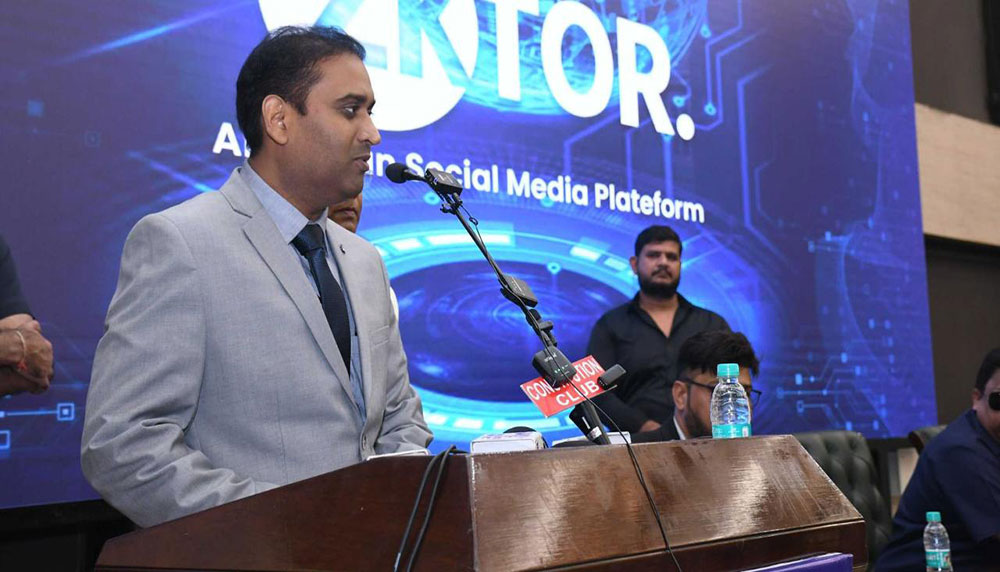
Softa Technologies founder Sunil Kumar Singh is advancing one of the most ambitious regional technology propositions to emerge from India: a privacy-first Indian social media platform that can connect India, Nepal, Bangladesh, Sri Lanka, Bhutan, Pakistan and the Maldives through shared trust architecture without reducing neighbouring societies to user markets, behavioural data pools or extensions of Indian digital authority. With ZKTOR as the social foundation, ZHAN as the contextual advertising layer, Ezowm as the hyperlocal commerce system, Subkuz as an independent information network and Hola AI as a culturally grounded intelligence layer, Softa is attempting to build a South Asian digital commonwealth organised around dignity, local capability, women and youth participation, regional employment and jurisdictional sovereignty.
South Asia presents one of the greatest contradictions in the global digital economy. Its societies are connected by geography, migration, language families, music, cinema, commerce, religion, food, family relationships and centuries of shared history, yet the region remains one of the least economically integrated parts of the world. The World Bank estimates that intraregional trade accounts for barely 5 per cent of South Asia’s total trade, compared with approximately 25 per cent in ASEAN. Current trade among South Asian countries remains far below its estimated potential, leaving neighbouring businesses and consumers less connected with one another than their physical and cultural proximity would suggest. At the same time, the World Bank continues to identify digital connectivity, regional cooperation, women’s economic empowerment and people-to-people relationships as important routes through which South Asia can create jobs, reduce poverty and develop more resilient regional markets.
The region’s digital future is advancing faster than its institutional integration. Smartphones, social platforms, digital payments, creator economies, online commerce and artificial intelligence increasingly shape everyday life from Delhi and Dhaka to Kathmandu, Colombo and Malé. Yet much of the infrastructure through which South Asians communicate, advertise, discover information and build online identities remains controlled by a small number of global platforms whose principal architectures were designed outside the region. These systems provide immense utility, but their commercial models, moderation assumptions, language priorities and data-governance structures do not always reflect the social realities of South Asian users. The region has become one of the world’s largest sources of digital participation without developing equivalent authority over the institutions governing that participation.
ZKTOR enters this gap as an Indian social media app with a regional rather than merely domestic ambition. Google Play publicly places the application within the 500K+ download category. Softa Technologies has separately reported that ZKTOR crossed half a million beta users across India, Nepal, Sri Lanka and Bangladesh, with Gen Z users and young women contributing significantly to early adoption. The company has announced plans to extend beta testing into Bhutan, Pakistan and the Maldives so that the platform can be examined across additional languages, legal environments and social contexts before wider deployment. Downloads, registrations, beta accounts, active users and retained communities are different measurements, but the public store milestone and multi-country rollout establish that ZKTOR has moved beyond a national concept into an operating South Asian platform test.
The most important question is not whether an Indian application can collect users across several neighbouring countries. Global platforms have demonstrated repeatedly that software can travel across borders. The more consequential question is whether India can build a regional social institution that expands Indian technological influence without reproducing the concentration, extraction and cultural distance for which foreign platforms are increasingly criticised. ZKTOR’s regional success will not be determined simply by the number of countries in which it becomes available. It will be determined by whether a Bangladeshi creator, Nepali student, Sri Lankan entrepreneur, Bhutanese merchant, Pakistani professional or Maldivian family experiences the platform as locally accountable rather than externally imposed.
That distinction defines the South Asian digital commonwealth. A digital commonwealth is not a single market controlled from one capital, and it is not a political union disguised as a technology product. It is a federation of users, creators, businesses, languages and institutions connected through common technical principles while retaining local authority over law, culture, operations and economic participation. India can provide architectural authorship, engineering scale and regional coordination without assuming that Indian ownership grants unrestricted authority over every neighbouring society. The platform can be Indian-led without becoming India-dominated.
Softa’s published regional model is designed around this distinction. The company states that its platforms are intended to operate through region-based deployment and jurisdiction-bound operational control, avoiding centralised cross-border behavioural data pooling. ZKTOR’s governance documentation says public participation can remain global while protected data and legal authority remain connected with the jurisdiction governing the user and infrastructure. Softa also says authorities in one region should not automatically gain access to protected data governed by another jurisdiction, and that technical limitations remain applicable even when commercial or legal pressure crosses borders. These are company-described architectural commitments rather than substitutes for country-specific legal review, but they provide the constitutional foundation through which a locally governed regional platform could be developed.
The resulting proposition is larger than regional expansion. ZKTOR can become the social foundation of a South Asian digital commonwealth in which neighbouring societies share secure communication, creator discovery, community formation and commercial opportunity without surrendering their identities to a central behavioural machine. ZHAN can connect local businesses with relevant audiences through language, geography and context. Ezowm can support commerce based on local prices, availability and fulfilment. Subkuz can provide independent regional and diaspora information. Hola AI can support languages, knowledge and practical assistance. The products can strengthen one another without requiring every signal generated through one service to explain the user inside all the others.
A Commonwealth, Not a Digital Colony
The language used to describe platform expansion matters because it reveals how the institution understands the societies it enters. A company can describe a country as a market, a user-acquisition territory, a data source or an advertising opportunity. Each description may be commercially accurate, but none is sufficient to establish regional legitimacy. A society contains institutions, laws, historical memories, languages and political sensitivities that cannot be reduced to the number of accounts available for monetisation.
South Asia possesses a long history of unequal economic and political relationships. Any Indian platform entering neighbouring countries will therefore be examined not only through product quality but through the question of power. Where will data be stored? Who will moderate public expression? Which legal authority can compel disclosure? Who receives advertising revenue? Will creators and merchants in smaller countries gain economic opportunity, or will value flow predominantly toward India? Will local languages shape the product, or will users be expected to adapt to Indian or English-dominant assumptions?
A centralised platform can offer identical features everywhere while remaining locally shallow. Translation may be available, yet moderation may not understand social meaning. Advertising may reach users, while merchant-support operations remain absent. Content may travel across borders, while grievance decisions are made by people unfamiliar with the relevant language or law. Local users provide activity, but institutional intelligence and high-value employment remain concentrated elsewhere.
The commonwealth model requires a different operating structure. ZKTOR can provide a shared technical foundation, but each country must develop its own professional capability. Bangladesh requires Bangla-language moderation, local business verification, women-safety expertise and legal understanding. Nepal requires Nepali-language creator support, commerce operations and grievance processes. Sri Lanka requires Sinhala and Tamil capability alongside locally accountable policy and media relationships. Bhutan and the Maldives require products adapted to smaller populations and distinct institutional environments. Pakistan requires Urdu and regional-language operations that cannot be governed as a minor extension of an Indian product.
Softa’s region-by-region rollout can become an advantage if it remains tied to operational readiness rather than marketing speed. The company says its phased launches are intended to test privacy, safety, hyperlocal infrastructure and regulatory alignment before broader expansion. This creates a slower path than releasing one central application everywhere, but it offers the opportunity to build legitimacy before aggressive monetisation becomes the primary objective.
The commonwealth approach also protects India’s long-term interests. A platform that enters neighbouring countries through centralised extraction may achieve rapid user growth while generating political resistance, regulatory conflict and public distrust. An institution that creates local employment, merchant opportunity and professional authority can become more durable because societies gain material reasons to support its presence.
India’s digital soft power will be strongest when neighbouring users choose Indian technology voluntarily because it is useful, safe and respectful. A Sri Lankan woman entrepreneur adopting ZKTOR, a Nepali creator building a community or a Bangladeshi merchant purchasing a ZHAN campaign provides stronger evidence of Indian influence than a patriotic campaign directed from India. Trust earned abroad carries greater international value than loyalty demanded at home.
Privacy as the Shared Constitutional Principle
A regional digital commonwealth requires a principle capable of surviving differences in language, politics and culture. Privacy provides such a foundation because every user, regardless of nationality, possesses an interest in maintaining boundaries around communication, personal media, commercial identity and private inquiry.
Softa describes ZKTOR as privacy and data safety by design, supported by Zero Knowledge Server Architecture, device-bound encryption principles, user-selected visibility and No URL Media Architecture. The company says private communications and protected media are designed to remain inaccessible to ordinary platform operations, while public visibility does not expose underlying storage or create unrestricted access to the user’s data.
This architecture carries particular significance in a cross-border environment. A conventional regional platform might centralise readable data because one shared pool improves recommendation, advertising and AI. Each additional country would make the system commercially stronger by contributing more relationships, languages, purchases and private behaviour to the central model. Users would gain wider connectivity, while the institution would gain progressively greater authority over the region.
Zero Knowledge constraints seek to prevent regional scale from becoming regional surveillance. A private conversation between users in Nepal should not become available to an Indian advertising system merely because the platform was developed in India. A Bangladeshi creator’s protected communication should not become training material for a regional AI model. A Sri Lankan woman’s safety report should not become a commercial category. The platform can deliver the function while limiting the institution’s ability to reinterpret the underlying human activity.
The constitutional value becomes clearer when future corporate change is considered. A regional platform may begin under a founder committed to privacy and later receive new investors, executives or acquisition offers. Political relationships may change. Governments may seek broader access. Information that remains readable can become valuable under incentives that did not exist when the user first joined. Technical limitation provides stronger continuity than the promise that every future leader will exercise restraint.
Privacy also makes the commonwealth more politically credible. Smaller countries are less likely to trust an Indian platform if every private signal accumulates under one central authority. Region-bound infrastructure and limited cross-border access can demonstrate that shared technology does not require surrendering national jurisdiction.
The architecture therefore protects several layers of sovereignty simultaneously. India gains a regional technology institution. Neighbouring countries retain legal and operational boundaries. Individual users retain protected private territory. Softa gains the ability to coordinate services without automatically gaining the right to know everything occurring within them.
No URL Media Architecture in a Region Where Reputation Travels Offline
Personal media carries unusually high social value across South Asia. Photographs and videos are connected with family identity, professional reputation, marriage, education, employment and local community relationships. When media is copied, manipulated or circulated without consent, the consequences can move rapidly from the platform into physical life.
Artificial intelligence has intensified that risk. A photograph can become material for synthetic sexual content, impersonation or fraudulent advertising. A voice can be cloned. A creator’s public identity can be reconstructed through media collected from several sources. A fabricated video may be proven false eventually, yet the target can suffer immediate damage among family members, customers, employers or community institutions.
Softa says ZKTOR’s No URL Media Architecture does not provide ordinary public URLs or shareable download links for user media, reducing common external extraction and scraping workflows. Users can decide whether posts are public, friends-only or private and whether comments, sharing or resharing are permitted. The architecture cannot eliminate screenshots, screen recordings, external cameras or misuse by authorised viewers, but it increases friction and reduces the ability to harvest media automatically at scale.
This design can become one of the strongest common principles available across South Asia because the technical mechanism does not require every society to define dignity identically. The publisher controls the intended audience. The platform reduces ordinary extraction routes. Local law and human review address the remaining cases. The architecture protects context without making one central moral authority responsible for every cultural judgment.
Women and girls stand to gain particular value. The GSMA’s 2026 data shows that South Asia continues to have one of the world’s widest mobile-internet gender gaps. Women in the region were 25 per cent less likely than men to use mobile internet in 2025, and approximately 330 million South Asian women remained offline. Safety and security concerns remain among the important barriers limiting women’s fuller use of mobile internet after access has been obtained.
Closing that gap is not simply a matter of supplying devices or reducing data prices. Women must believe that the services available through those devices will not turn visibility into permanent vulnerability. No URL Media Architecture, private communication boundaries and contextual advertising can contribute to a safer environment in which women participate professionally and socially without assuming that personal media will become effortlessly extractable.
The economic importance is substantial. The GSMA estimates that closing the mobile-internet gender gap across low- and middle-income countries could add approximately $1.3 trillion in additional GDP between 2023 and 2030 and create major commercial benefits for the mobile industry. These are global estimates rather than forecasts for ZKTOR, but they demonstrate the economic scale of women’s suppressed digital participation.
A South Asian digital commonwealth that earns women’s confidence can therefore generate a regional participation dividend. More women can become creators, merchants, professionals, journalists, moderators and customers. Families may support younger women’s online activity more readily. Local businesses gain new operators and audiences. Trust becomes regional economic infrastructure rather than a narrow safety feature.
Gen Z and Gen Alpha as Regional Citizens
Softa reports that much of ZKTOR’s early South Asian adoption has come from Gen Z users and young women. This is strategically important because younger South Asians are not only a large audience. They are the generation most capable of creating a shared regional digital culture outside formal political institutions.
Young people in India, Bangladesh, Nepal, Sri Lanka and Pakistan already encounter one another through music, gaming, sport, cinema, education, creator culture and online communities. Their digital relationships often develop faster than regional trade or government cooperation. Social platforms can turn this cultural proximity into mutual understanding, but they can also amplify hostility, misinformation and national stereotypes when engagement systems reward conflict.
A commonwealth platform must therefore make cross-border discovery possible without allowing outrage to become the principal mechanism through which neighbouring societies encounter one another. ZKTOR’s published model says content visibility should follow user choice, search, relationships, community context and regional relevance rather than behavioural systems designed primarily to maximise emotional reaction and time spent.
This can create a healthier basis for regional youth culture. A Nepali musician can reach Indian and Bangladeshi audiences because people search for the genre or participate in related communities. A Sri Lankan technology creator can build a South Asian following through expertise. A Pakistani educator can reach students interested in the subject without political controversy becoming the primary distribution signal. A Bangladeshi entrepreneur can share knowledge with women-led businesses elsewhere in the region.
A post-algorithm approach does not remove political disagreement or guarantee harmony. Nor should it. South Asian societies contain real historical conflicts and legitimate differences. The platform’s responsibility is not to manufacture artificial unity. It is to avoid making hostility the most commercially rewarding form of regional interaction.
Gen Alpha introduces an additional responsibility. Children entering the AI age will produce media, voice samples, relationships and behavioural signals before understanding their future value. A privacy-first regional platform should allow young people to communicate and create without turning every temporary interest into a permanent commercial identity. Purpose-bound AI, restricted media extraction and non-profiled discovery can preserve greater developmental freedom.
Youth participation also creates a future regional workforce. The same users who begin through social communities can become creators, language evaluators, campaign managers, moderators, journalists, merchant-support professionals and AI specialists. The digital commonwealth becomes economically durable when young people operate the infrastructure rather than merely consuming content through it.
Language as Regional Infrastructure
No South Asian platform can become genuinely regional through translation alone. The region contains several major languages, multiple scripts, extensive dialect diversity and constant code-switching. Language carries humour, social hierarchy, political meaning, family reputation and commercial trust. A literal translation can reproduce words while missing the reason the words matter.
ZKTOR’s South Asian rollout is explicitly being used to test the platform across diverse user groups, languages and digital environments. Softa presents regional language and cultural context as core elements of its hyperlocal design rather than additions to an otherwise uniform global product.
The commonwealth model requires language authority to remain distributed. Bangla should not be moderated only through systems developed for Hindi or English. Sinhala and Tamil require local cultural and political understanding. Nepali cannot be treated as a minor localisation category. Urdu and other Pakistani languages require professionals capable of distinguishing ordinary expression, coded harm, political disagreement and regional context.
Hola AI can become the intelligence layer supporting this linguistic federation. Softa describes it as culturally grounded and voice-first, intended to support knowledge, safety and practical assistance without behavioural tracking or personal-data extraction as its default model.
The phrase culturally grounded must be applied carefully. Culture should help the system understand a person’s language and circumstances, but it should not become a mechanism through which the AI assigns fixed identities or enforces restrictive social norms. A woman seeking assistance should not receive an answer based solely upon what the system assumes women in her community should do. A young person should not be permanently classified through temporary linguistic or cultural activity. Understanding context must expand individual capability rather than reduce individual freedom.
Language can also become a major employment layer. Regional moderators, translators, AI evaluators, customer-support professionals, journalists and campaign managers will be necessary in every market. A South Asian digital commonwealth should treat linguistic knowledge as professional technology capability rather than low-cost annotation labour.
This creates regional equality within the ecosystem. A smaller market may produce fewer users than India, but its language professionals and cultural institutions retain authority over how the platform operates locally. The commonwealth becomes a network of knowledge centres rather than a central Indian product translated outward.
ZHAN and a Regional Advertising Economy Without Behavioural Colonisation
Advertising is where regional integration can become either economically empowering or institutionally extractive. A platform entering several South Asian markets can combine activity across countries to develop increasingly precise behavioural prediction. The resulting intelligence is valuable, but local businesses and users may possess little understanding or control over how it was created.
ZHAN represents Softa’s proposed alternative. The company says its hyperlocal advertising model is intended to generate relevance through location, language and context rather than persistent behavioural profiling.
This is well suited to South Asia’s commercial structure. A restaurant in Kathmandu needs nearby customers, not a psychological model of the entire regional population. A tutor in Dhaka needs families interested in education within a realistic service area. A creator in Colombo needs partnerships with businesses relevant to the language and audience. A merchant in Bhutan needs visibility within a small but trusted local market.
Contextual advertising allows the platform to serve these needs without transforming every user into a cross-border commercial dossier. The reason an advertisement appears remains more comprehensible. The business serves the location, the subject is relevant and the language matches the audience.
The regional economic value can be substantial because small enterprises often lack access to sophisticated digital advertising. Local campaign professionals can help businesses establish identity, create material, choose a realistic market and understand performance. Creator coordinators can connect brands with trusted voices. Merchant-verification teams can reduce fraud. Language specialists can ensure that commercial communication reflects the society rather than sounding mechanically translated.
These roles should exist in every country. A ZHAN operation for Bangladesh should create Bangladeshi employment and commercial capability. Sri Lankan campaigns should be managed through local knowledge. Nepalese businesses should not need Indian agencies to interpret every customer relationship.
The resulting network can become a South Asian advertising commonwealth in which businesses gain regional interoperability while local professionals retain market intelligence. India supplies architecture and investment capacity, but economic knowledge remains distributed.
This is the opposite of behavioural colonisation. The platform does not treat the region’s collective psychology as one asset controlled from India. It treats local context as value created and governed close to the market.
Ezowm and the Regionalisation of Local Commerce
South Asia’s limited intraregional trade demonstrates how difficult it remains for neighbouring businesses to reach one another even when geographic and cultural distance is relatively small. The World Bank continues to estimate that regional trade is a fraction of its potential and argues that stronger connectivity, digitalisation and market cooperation could increase prosperity and employment.
Ezowm cannot solve customs barriers, payment regulation or geopolitical restrictions by itself. Its potential contribution lies at the local and digital-discovery level. Softa describes Ezowm as a hyperlocal commerce initiative designed around local prices, availability, fulfilment and livelihoods. It is not intended to replace kirana stores or local traders with one central warehouse model, and the company says pilot programmes are underway with phased rollout planned from 2027.
Within the South Asian commonwealth, Ezowm can first strengthen commerce inside each local market. A merchant gains a verified identity through ZKTOR, contextual visibility through ZHAN and transaction support through Ezowm. Local fulfilment and customer support remain connected with the district or country. Hola AI can assist language and business communication.
Regional commerce can develop later where law, logistics and demand allow it. A Nepali craft producer may reach diaspora customers. A Sri Lankan creator may support regional products. A Bangladeshi enterprise may connect with communities beyond its immediate market. Subkuz can provide credible information connecting diaspora and home regions.
Purpose separation is essential. A transaction should be processed for payment, fulfilment, fraud prevention and dispute resolution. It should not automatically become social identity or advertising intelligence across the entire region. One purchase can reveal religion, health, family circumstances or financial pressure. A commonwealth built around dignity must not turn regional commerce into regional surveillance.
Merchant sovereignty matters equally. Local sellers should retain a meaningful customer relationship and commercial identity. Ezowm’s value should come from enabling digital visibility and fulfilment rather than making every merchant dependent upon hidden ranking or central pricing power.
The employment implications are direct. Softa identifies seller onboarding, fulfilment coordination, customer support and quality workflows as intended roles within Ezowm’s local operating model. The company also states that regional language and cultural familiarity should be treated as strengths and that digital opportunity should be created closer to where people live.
The commerce commonwealth will become credible when each participating society gains operators, merchants and professional capability rather than serving only as a source of transactions.
Subkuz and a Shared Information Sphere Without Central Narrative Control
South Asian societies know surprisingly little about one another through sustained, locally grounded journalism. Major events cross borders, but everyday economic, cultural and institutional developments frequently remain confined within domestic information systems. Social media fills part of the gap, although forwarded content and viral fragments often travel without verification or context.
Subkuz is designed as Softa’s hyperlocal and diaspora information layer with independent editorial governance. The company says it is intended to generate contextual advertising revenue without personal profiling and to remain institutionally capable of examining Softa and its products rather than functioning as their promotional arm.
A regional Subkuz network could provide a more durable information bridge among South Asian societies. Local reporters in Bangladesh, Nepal and Sri Lanka could explain economic, cultural and public developments to domestic and regional audiences. Diaspora communities could remain connected with home districts. Creators and experts could translate complex regional events without reducing them to national rivalry.
Editorial independence is indispensable. A South Asian digital commonwealth cannot be governed through one favourable narrative about India, Softa or ZKTOR. Subkuz should retain the authority to investigate platform failures, commercial partners, governments and cross-border disputes. A regional information institution earns trust because it can publish facts that the parent company might prefer not to amplify.
Reader privacy must also remain protected. What a person reads can reveal political interests, health concerns, religion and economic uncertainty. Subkuz should not become a hidden source through which ZHAN builds commercial profiles or ZKTOR shapes social recommendations. Information must be capable of crossing borders without the reader becoming institutionally transparent.
This creates a form of information sovereignty compatible with regional connection. Each country retains journalists and editorial authority. The common platform improves reach and cooperation. No single corporate or national centre owns the complete narrative.
Hola AI and a Federation of Knowledge
Artificial intelligence could become either the strongest unifying layer of the South Asian digital commonwealth or its most dangerous centralising force. A shared AI system can support translation, education, commerce, accessibility and safety across several languages. It can also absorb private questions, cultural knowledge and regional behaviour into one institution capable of explaining users more deeply than any earlier platform.
Softa positions Hola AI as a culturally grounded intelligence layer for knowledge preservation, practical assistance and narrow safety purposes rather than unrestricted behavioural prediction. Its official materials state that the system should not analyse beliefs, create political classifications or replace human judgment in consequential decisions.
The commonwealth model requires Hola AI to operate as a federation of knowledge rather than a central intelligence extracting from every participating society. Bangla, Nepali, Sinhala, Tamil, Urdu, Dhivehi and other languages should not simply provide data for an Indian-centred model. Regional experts should participate in evaluation, governance and product design. Communities should retain dignity and agency over cultural knowledge contributed to the system.
The privacy of the prompt is the decisive boundary. A user may ask Hola AI about health, debt, harassment, education or employment. These questions can expose profound vulnerability. They should not automatically become advertising signals, commerce profiles or social recommendation categories.
Explicit coordination remains valuable. A creator can ask Hola AI to translate a ZKTOR post. A merchant can request an Ezowm description. A campaign professional can prepare ZHAN material. The user chooses the connection and understands the task.
A federated AI layer can also support regional safety. It can help detect narrow categories of harmful public content, assist translation for human reviewers and identify synthetic impersonation signals. Softa’s governance model says consequential actions should proceed through structured human review rather than automatic irreversible punishment.
This creates work for language evaluators, cultural specialists, safety professionals and domain experts throughout South Asia. Intelligence becomes a regional profession rather than a system built in one country and imposed upon the others.
Women as Founders of Regional Legitimacy
The South Asian digital commonwealth will be judged most seriously through women’s experience because women often carry the highest social and economic cost when platform boundaries fail. A platform that gains male users rapidly while women remain cautious cannot claim complete regional legitimacy.
The GSMA’s 2026 findings show that South Asia’s mobile-internet gender gap remains 25 per cent, despite substantial progress since 2017. Approximately 330 million women in the region remained unconnected to mobile internet in 2025, while affordability, digital skills, safety and security continued to restrict adoption and fuller use.
ZKTOR’s early reported acceptance among young women is therefore strategically important, although adoption figures alone do not establish long-term trust. Women must remain active as creators, professionals, merchants and platform operators. They must be represented inside moderation, product, policy and regional leadership.
The architecture can support this participation through controlled visibility, protected communication, restricted media extraction and contextual advertising. The wider ecosystem can convert confidence into income. ZHAN can help women-led businesses reach relevant local audiences. Ezowm can support transactions. Subkuz can create journalism and information roles. Hola AI can reduce language and knowledge barriers.
Local women must also govern the systems intended to protect them. A central Indian team cannot fully understand how digital harm interacts with Bangladeshi, Nepali, Sri Lankan, Bhutanese, Pakistani or Maldivian social structures. Women-safety specialists, moderators and community organisations should shape operations within every market.
Women’s participation becomes both an economic dividend and an institutional test. A platform trusted by women can gain family acceptance, creator diversity, merchant density and public legitimacy. A platform that fails women may achieve scale but remain socially fragile.
The Trust Workforce as the Commonwealth’s Economic Foundation
The strongest regional platform is not the one that employs people only at its headquarters while automating every local relationship. The digital commonwealth needs a distributed trust workforce capable of translating shared architecture into locally accountable service.
ZKTOR requires regional moderators, grievance professionals, creator-support teams and cybersecurity operations. ZHAN requires merchant verification, campaign management and language expertise. Ezowm requires seller onboarding, fulfilment and customer support. Subkuz requires reporters, editors and translators. Hola AI requires language evaluators, domain specialists and safety reviewers.
These roles are not peripheral corporate-social-responsibility projects. They are necessary because context cannot be centralised completely without reducing product quality. A moderator unfamiliar with the language can miss harm. An advertiser unfamiliar with the district can waste a merchant’s budget. An AI system developed without local evaluation can misunderstand cultural meaning. A newsroom without local reporters cannot produce credible regional journalism.
Softa’s published vision connects its regional and district architecture with jobs closer to where people live, particularly in language, community operations, advertising, commerce and AI. The company’s investor and product materials identify local capability building as part of its long-term operating model.
Employment quality will matter as much as employment quantity. Trust cannot be built through moderators, contractors or commerce workers treated as invisible and disposable. Training, compensation, psychological support, professional progression and grievance systems should become part of the same institutional standard ZKTOR promises users.
The workforce must also be genuinely regional. India can host architecture, research and global leadership, but neighbouring countries should develop their own senior professionals and operating authority. A commonwealth cannot remain locally governed if all consequential careers lead back to one Indian centre.
The resulting human network can become one of Softa’s most defensible assets. Features can be copied. Years of relationships, language competence, merchant knowledge and governance experience cannot be recreated instantly.
Sunil Kumar Singh and the Founder’s Regional Test
Sunil Kumar Singh’s founder narrative connects rural Bharat with more than two decades of professional and social exposure to Finland and the wider Nordic environment. Softa says this combination shaped a technology philosophy joining Bharat’s linguistic and economic complexity with Scandinavian institutional trust and long-term engineering.
The South Asian commonwealth is the most demanding test of that philosophy because the founder must apply institutional restraint not only to users but to India’s own regional power. Singh can present ZKTOR as an Indian achievement while acknowledging that Indian authorship does not create a right to centralise neighbouring societies.
Finland contributes the concept that trusted digital systems can create commercial and international value. Bharat contributes scale, language, district commerce and the urgent need for technology reflecting family and community realities. South Asia adds another layer: the architecture must travel without becoming culturally or politically imperial.
Singh’s strongest regional stature will come not from presenting himself as the technological leader of South Asia, but from building an institution in which leadership is distributed. Local professionals, creators, journalists and merchants should gain meaningful authority. Country-level systems should not depend upon the founder’s personal understanding of every society.
This is where the description of Singh as a quiet technology statesman can acquire genuine substance. Statesmanship in a regional platform does not mean accumulating the greatest possible power. It means designing limits around the power India and Softa inevitably gain as the architecture expands.
His success will be measured by whether Nepalese, Bangladeshi, Sri Lankan and other regional users consider the platform theirs in practical experience even while recognising its Indian origin.
No VC, No Grants and the Freedom to Choose a Slower Regional Model
Softa’s official investor materials state that the company has raised no venture capital to date, received no government grants in India or Finland and remains debt-free. The company says Singh declined conventional early funding routes to preserve architecture and strategic independence.
This capital structure is directly relevant to South Asian expansion. Investor pressure can reward rapid country launches, centralised infrastructure and immediate advertising revenue before local governance systems are ready. The fastest regional strategy would be to deploy one application, collect behavioural data centrally and monetise the combined audience through a common advertising engine.
Softa’s independence gave it the freedom to articulate a slower, region-by-region model based upon safety, jurisdiction and hyperlocal operations. ZKTOR could test the platform in India and Nepal before expanding further. Sri Lanka and Bangladesh could become distinct operational environments rather than merely additional acquisition campaigns. Bhutan, Pakistan and the Maldives could enter through beta testing intended to reveal legal and cultural differences.
No government grants add another form of regional credibility. ZKTOR can be an Indian-origin platform without appearing as an instrument of Indian government funding or policy influence. It can cooperate with public institutions while remaining a private company responsible for earning user trust independently.
The Finland dimension reinforces the same point. Singh absorbed Nordic institutional experience, but Softa says it did not depend upon Finnish government grants for its development. The commonwealth is therefore not a bilateral government project extended into South Asia. It is an independently built Indian technology architecture informed by international experience.
Debt freedom removes a repayment clock that might otherwise force premature monetisation. Local teams, language operations and safety systems can be developed before each country is expected to generate maximum revenue. The cost is slower expansion and greater pressure upon founder capital and operational discipline.
The model will eventually require substantial investment. Regional infrastructure, cybersecurity, moderation, AI, commerce and professional teams cannot scale indefinitely without capital. The strategic advantage lies in choosing capital after the commonwealth constitution has been defined.
Aligned investors can finance country-level operations, independent audits and regional employment. Misaligned investors may seek centralisation and behavioural monetisation. Singh’s earlier refusal gives Softa a stronger position from which to distinguish between them.
Policy Federation Without Regulatory Arbitrage
South Asian countries maintain different privacy, content, cybersecurity, media and commercial laws. A regional platform could exploit those differences by locating sensitive operations in the least restrictive jurisdiction while serving users elsewhere. Such regulatory arbitrage might reduce costs, but it would weaken the legitimacy of the commonwealth.
Softa’s jurisdiction-bound model suggests the opposite approach. Data and operations should remain connected with the relevant legal boundary, while the shared architecture establishes common minimum principles such as privacy, restricted profiling, user-controlled visibility and human review.
This allows policy diversity without abandoning institutional consistency. Each country can enforce its own lawful requirements. ZKTOR can preserve common technical limits concerning protected communication and media extraction. Local grievance systems can operate within national law, while regional coordination addresses cross-border impersonation, fraud and security incidents.
The company must remain transparent about conflicts. A local law may require action that users or the company consider restrictive. Another jurisdiction may demand information the architecture cannot access. A commonwealth platform cannot promise that every national policy will be compatible with one universal vision of freedom or privacy.
The credible response is procedural. Softa should identify what the architecture can provide, what lawful authority applies and where technical limits make compliance impossible. Users should understand which country governs their data and how cross-border requests are handled.
Independent technical and legal assurance will become increasingly important. Softa says ZKTOR is planned to undergo independent security and privacy audits after regional beta deployment milestones, with infrastructure partners expected to support jurisdiction-specific hosting and resilient operations. A planned assessment is not completed verification, but it reflects recognition that regional claims must eventually be examined outside the company.
A policy federation becomes credible when shared principles survive different national pressures without allowing one government, including India’s, to exercise silent regional reach.
India’s Soft Power Through Service, Not Supremacy
India has the scale, talent, capital markets and engineering capability to become the principal technology builder within South Asia. That position brings opportunity and responsibility. A platform built in India can strengthen the region or deepen dependency according to how its power is exercised.
ZKTOR’s national-pride value should not be built upon the claim that neighbouring users should prefer it because India created it. Such a message may appeal domestically but offers little reason for another society to trust the platform. Product quality, privacy, language, economic opportunity and local accountability must earn adoption independently.
The South Asian digital commonwealth can become a powerful form of Indian soft power because service replaces supremacy. India provides secure architecture, product development and international coordination. Local societies receive user protection, creator opportunity, commerce infrastructure, information capability and employment. The platform’s Indian identity becomes associated with enabling other countries rather than absorbing them.
This model can strengthen India’s position beyond South Asia. Emerging markets elsewhere face similar tensions between the utility of global platforms and discomfort with concentrated behavioural power. A regionally federated ZKTOR system could offer an alternative template for multilingual societies seeking shared technology without centralised extraction.
India’s international stature would increase because it produced an original governance and business model, not merely because an Indian app gained downloads. The world already knows that India can provide engineering talent and large consumer markets. The commonwealth could demonstrate that India can author trusted multinational digital institutions.
The Future-Unicorn Case for a Regional Trust Platform
The South Asian digital commonwealth creates a significant investment thesis because it places Softa at the intersection of social networking, secure communication, regional-language content, contextual advertising, hyperlocal commerce, information and culturally grounded AI.
ZKTOR provides the distribution and identity layer. ZHAN can produce advertising revenue through local context. Ezowm can produce transaction and merchant-service revenue. Subkuz can develop contextual information economics. Hola AI can create language, productivity, safety and enterprise value.
The region’s continuing economic growth and expanding digital-services opportunity provide a large market context. The World Bank projected South Asian growth of 6.3 per cent in 2026 and has identified digital services, business-environment improvements, connectivity and job creation as important elements of the region’s economic future. These macroeconomic projections do not guarantee Softa’s success, but they show that the company is entering a region where digital capability and employment will remain strategically significant.
The investment case becomes compelling only when regional trust produces measurable behaviour. ZKTOR must retain active users rather than merely generate downloads. Creators must build audiences and income. ZHAN must secure repeat campaigns. Ezowm must complete reliable transactions. Subkuz must build credible readership. Hola AI must solve practical problems while preserving prompt privacy.
Regional operations must also become economically sustainable. Local employment and jurisdictional infrastructure are valuable but costly. Softa must demonstrate that country-level teams improve retention, safety, merchant demand and regulatory resilience sufficiently to justify the additional complexity.
The moat would arise from accumulated institutional capability. A competitor can copy a feed, encrypted messaging or an advertising interface. It cannot instantly recreate creator communities, local merchants, multilingual trust teams, jurisdictional infrastructure, women’s confidence, editorial relationships and regional governance experience.
A future billion-dollar valuation cannot be guaranteed by describing ZKTOR as South Asia’s safest social media platform or by multiplying the region’s population by an assumed revenue rate. The credible thesis is that Softa may be building an unusually defensible Indian trust-technology institution across several connected markets.
Its value would come not from knowing every South Asian user more intimately than competitors, but from creating sufficient utility and confidence that users, merchants and institutions choose to remain despite the company knowing less.
The Digital Commonwealth South Asia Has Never Had
South Asia’s political institutions have struggled to produce the level of regional integration achieved elsewhere. Trade barriers, historical conflict, infrastructure gaps and national sensitivities continue to restrict cooperation. Technology cannot resolve those conflicts, and no private platform should pretend to become a substitute for diplomacy.
Digital institutions can nevertheless create forms of practical cooperation below the level of formal politics. Creators can build cross-border audiences. Merchants can discover neighbouring markets. Students can join educational communities. Journalists can explain one society to another. Women entrepreneurs can share professional knowledge. Families and diaspora communities can remain connected with places of origin.
ZKTOR can provide the social foundation for these relationships if the architecture does not reward conflict, centralise private data or impose one national perspective. ZHAN can create commercial relationships without behavioural ownership. Ezowm can strengthen local commerce before supporting lawful regional trade. Subkuz can develop a shared information sphere without surrendering editorial independence. Hola AI can translate and assist without absorbing the region’s knowledge into one central authority.
The commonwealth’s strength would lie in shared principles and distributed power. Privacy would be common. Jurisdiction would remain local. Technology would be Indian-led. Governance and economic participation would be regional. Users would connect across borders without becoming one unrestricted data pool.
Sunil Kumar Singh’s role is to establish this constitution before scale and capital make centralisation difficult to resist. His rural Bharat background and Finland experience provide a distinctive institutional lens. Bharat supplied understanding of language, family, commerce and social consequence. Finland supplied sustained exposure to high-trust institutions and disciplined engineering. Softa’s no-VC, no-grant and debt-free formative phase supplied the independence through which those ideas could be translated before conventional growth pressure became dominant.
The project now faces its most important test. It is relatively easy to speak about local sovereignty while the platform remains in beta. It becomes more difficult when regional advertising revenue grows, AI gains access to more languages, governments demand cooperation and investors seek economies of scale. Centralising data, moderation and commercial intelligence may eventually appear cheaper and more efficient.
The digital commonwealth will survive only if Softa continues to believe that efficiency is not the highest institutional value. Local authority, privacy, user dignity and regional trust may require more complex and expensive operations. Those costs are not necessarily weaknesses. They may become the source of the legitimacy and commercial defensibility competitors cannot reproduce easily.
India’s first major social-platform ambition was to prove that it could build a domestic alternative. The South Asian digital commonwealth asks a more difficult question. Can India build a regional institution powerful enough to connect neighbouring societies and disciplined enough not to dominate them?
If ZKTOR and the Softa ecosystem answer that question successfully, the achievement will extend far beyond half a million beta users or one future-unicorn valuation. India will have demonstrated that technological leadership does not require cultural uniformity, behavioural extraction or the concentration of every regional relationship inside one corporate centre. It will have built an Indian social media platform whose regional power grows because the countries around India remain sovereign participants within it. That would be more than a successful expansion strategy. It would be the beginning of South Asia’s first true digital commonwealth.