
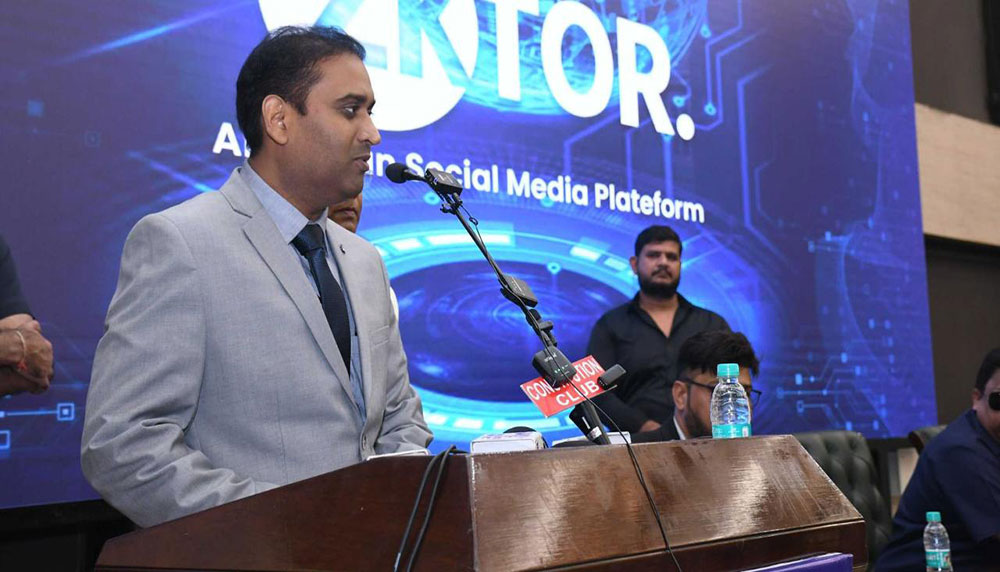
As ZKTOR approaches one million downloads during South Asia mass public testing, Sunil Kumar Singh’s Bharat-rooted technology group is connecting protected social identity, bounded artificial intelligence, independent local journalism, contextual advertising, merchant sovereignty and rural production through a no-VC, no-government-funding and ISRO-inspired digital model
NEW DELHI, SPECIAL NEWS ANALYSIS
For most of the internet era, privacy was treated as a control placed around technology after the product had already been designed. Users were given passwords, settings, consent screens and legal notices, while the commercial machinery beneath the service continued to collect, connect and interpret as much information as its business model allowed. Artificial intelligence has made that sequence increasingly untenable. Photographs now supply faces for synthetic identities, reels provide voice and movement, conversations reveal emotional and financial vulnerability, and social relationships identify the people whose names can make a false message believable. Data that once improved advertising can now train generative systems, automate impersonation and reproduce a person’s identity without their knowledge. Softa Technologies Limited was built around the conclusion that privacy could no longer remain a policy surrounding technology. It had to become part of the infrastructure through which communication, intelligence, media and commerce operate.
ZKTOR is the clearest expression of that strategy. The Bharat-built super social-media platform has approached one million cumulative downloads during its South Asia mass public testing phase, combining encrypted private and group messaging, audio and video calls, feeds, status updates, photographs, reels, long-form videos, pages, clubs, communities, creator tools and local discovery inside one privacy-first social environment. India, Nepal, Bangladesh and Sri Lanka form its active regional base, while the wider Softa model addresses the connected youth, diaspora and local economies of Pakistan, Bhutan, Maldives and the broader Afghan market context. Strong participation from Gen Z users and young women gives the milestone a significance larger than raw distribution. It shows that the groups most exposed to algorithmic pressure, unsafe media reuse and identity-based abuse are placing visible confidence in a platform whose central promise is not more prediction, but greater control.
The proposition distinguishes ZKTOR from social networks that add encrypted messaging or privacy controls to systems still financed by extensive behavioural knowledge. Softa has integrated Zero Knowledge Server Architecture, No URL Media Architecture, end-to-end encryption, data minimisation, restricted internal access, region-bound data governance, user-controlled visibility, human-reviewed moderation and non-profiling monetisation into the platform’s operating model. ZKTOR retains the expressive and social tools that attract mass audiences, but it rejects the assumption that every interaction must become part of a permanent psychological or commercial profile. Its architecture is designed to support expression without unrestricted exposure, community without blanket surveillance and economic activity without behavioural exploitation.
This is not merely a stronger privacy proposition. It is a different theory of corporate power. A conventional platform may technically possess broad visibility into users and rely upon policy, reputation and management restraint to prevent misuse. ZKTOR reduces the amount of authority available to the platform itself. Protected communication remains outside routine operational visibility, media is not exposed through conventional public download links, and information collected for one purpose is not treated as universal property of the entire ecosystem. The user is not asked to trust every future employee, investor, acquirer or government request equally. Technical boundaries narrow what those actors can reach without changing the architecture. That limitation creates the foundation for Softa’s larger trust-technology strategy.
When every photograph becomes an AI input
The value of ZKTOR’s architecture becomes clearer when ordinary social content is viewed through the capabilities of generative AI. A photograph contains facial structure, clothing, professional context and environmental clues. A reel adds voice, accent, movement and background activity. A social graph identifies family members, colleagues, customers and influential community figures. Location and interaction patterns reveal routines. When combined, these signals allow malicious operators to build fabricated endorsements, cloned voices, false accounts, sexualised deepfakes and targeted financial scams with a level of realism that previously required far greater expertise and cost.
The most serious risk is not confined to famous people or public officials. A home-based entrepreneur can be copied into a fraudulent store. A student’s photograph can be altered into humiliating content. A doctor can appear to endorse an unsafe product. A creator’s reel can become a synthetic advertisement. A journalist’s voice can be placed inside a political statement never made. A family video can reveal the relationships required to make an emergency-payment scam credible. AI has lowered the cost of producing the fabrication, while platforms built around publicly retrievable media and detailed relationship data have supplied the raw material.
ZKTOR’s No URL Media Architecture addresses one of the most important supply routes behind this economy. Photographs and videos remain accessible inside the platform according to the publisher’s visibility choices, but they are not exposed through ordinary public media URLs or conventional shareable download links. This closes the standard link-based route through which automated systems scrape and harvest media at industrial scale. A determined recipient may still misuse something legitimately viewed, but the platform does not make millions of files available through the routine addressable structure on which mass extraction depends.
The distinction between individual copying and automated harvesting is central to ZKTOR’s value. One act of misconduct requires direct access and deliberate effort. Bulk scraping creates reusable datasets capable of powering facial-recognition systems, synthetic-content factories, cloned creator libraries and fraud networks. No URL Media Architecture materially raises the cost of building those collections. It allows a person to be visible inside a chosen social context without automatically turning the original file into a freely addressable internet resource.
This is why the architecture is particularly important for women and girls. The consequences of manipulated media often extend far beyond an online profile, affecting education, employment, marriage, family confidence, business reputation and participation in public life. A safety system that begins only after harmful content is reported responds after the identity has already been extracted and redistributed. ZKTOR moves the first line of defence into the media infrastructure itself. Controlled delivery, user-selected audiences, restricted resharing, encrypted communication and accountable review operate before misuse becomes a viral event.
For creators, the same architecture protects intellectual and commercial identity. Photographs, performances, designs, voice, educational videos and personal presentation are assets through which creators build audience and income. Conventional social platforms often give them visibility while making their source material easy to copy and their audience dependent on opaque ranking systems. ZKTOR connects stronger media protection with direct relationships, communities and creator tools, allowing the creator to build economic value without accepting unrestricted extraction as the admission price.
Zero Knowledge changes who holds power
No URL Media Architecture limits ordinary external extraction. Zero Knowledge Server Architecture limits internal concentration. ZKTOR’s design places private communication and protected media behind encryption and restricted access so that the central service does not maintain universal operational visibility. Softa’s governance framework describes media protection, segmented information and constrained review interfaces as parts of a system intended to prevent protected content from becoming routinely available to staff or central administrators.
That structure matters because corporate promises can change more easily than technical capability. A new investor can demand higher monetisation. An acquirer can pursue a different data strategy. A government can request broader access. An employee can misuse privileges. A platform that stores readable copies of everything must rely repeatedly on institutional restraint. A platform engineered to lack universal access reduces the scale of power available to be redirected.
The result is privacy by architecture rather than privacy by discretion. Banks can use secure channels without allowing customer conversations to become advertising profiles. Schools and universities can operate verified communities without converting student activity into permanent behavioural categories. Creators can separate public identity from protected collaboration. Merchants can communicate with customers without exposing family and private relationships. Public institutions can maintain authenticated accounts without requiring the platform to hold a universal social and psychological map of the people receiving the message.
Data minimisation strengthens cybersecurity as well as privacy. A company that avoids collecting unnecessary behavioural information has less sensitive material available to attackers, insiders and future secondary uses. The difference is not simply that ZKTOR places stronger locks around a larger warehouse. Its business architecture reduces the need to build the warehouse. That design lowers exposure while creating a cleaner basis for compliance, institutional adoption and responsible artificial intelligence.
Region-bound data governance extends this limitation across South Asia. ZKTOR’s architecture is designed around jurisdiction and regional operations rather than one central global behavioural pool. Shared technology allows communication across borders, while local law, language, governance and operational responsibility remain meaningful. This federated structure gives neighbouring countries access to Indian engineering without requiring them to surrender every user relationship to one central data authority.
The post-algorithm generation
ZKTOR’s strong Gen Z response is significant because younger users understand both the attraction and the cost of modern platforms more intimately than any previous generation. They use reels, communities and creator identities naturally, but they have also grown up with unpredictable reach, algorithmic pressure, comparison anxiety, engagement manipulation and permanent digital memory. Generation Alpha is entering the same environment at a time when synthetic content and AI-generated personalities are becoming indistinguishable from ordinary media.
Softa’s model does not reject the social formats young users value. It redesigns the incentives surrounding them. ZKTOR provides reels, public profiles, pages, communities, clubs and discovery without placing hidden behavioural scoring at the centre of distribution. Its published philosophy rejects engagement systems designed primarily to maximise time spent and instead emphasises direct relationships, contextual relevance and continuity.
This gives the platform a distinctive position as a Gen Z trust network and post-algorithm social environment. Young users retain creative expression without becoming only sources of predictive data. Creators build communities around deliberate following and relevance rather than depending entirely on emotionally optimised feeds. Regional language and local identity are treated as product strengths instead of secondary localisation requirements.
The economic importance lies in what happens after the user joins. ZKTOR connects young people with the wider Softa ecosystem as creators, journalists, language specialists, campaign professionals, merchants, moderators, AI evaluators and agricultural technology workers. A student can build a portfolio, operate a community or become a regional creator. A local-language specialist can contribute to HOLA AI. A reporter can work through Subkuz. A designer can serve advertisers through ZHAN. A young entrepreneur can trade through Ezowm. An agricultural professional can join Green Gold’s processing and traceability network.
The model therefore shifts the youth narrative from consumption to capability. Every creator, moderator, editor, merchant adviser and district operator deepens the ecosystem while generating skills and income. Softa’s network becomes more valuable not when young people merely spend additional minutes scrolling, but when their digital identity produces creativity, commerce, information, employment and local economic activity.
Women’s safety becomes a growth engine
The strong participation of young women during ZKTOR’s South Asia testing reflects a market need that conventional platform metrics frequently underestimate. Women may gain enormous value from digital visibility, but the cost of unsafe exposure remains disproportionately high. Photographs can be sexualised, business profiles can be impersonated, phone numbers can attract harassment and public expression can trigger campaigns targeting family and personal reputation. A platform that reduces these risks expands the number of women willing to participate as professionals, creators, entrepreneurs, journalists and public leaders.
ZKTOR provides the protected social layer through encrypted communication, No URL Media, controlled visibility and human-reviewed enforcement. ZHAN provides contextual customer discovery without targeting personal vulnerability. Ezowm provides commerce while separating public business identity from unnecessary private exposure. HOLA AI reduces language and digital-literacy barriers. Subkuz provides credible visibility for local professionals and women-led enterprises. Green Gold connects rural women with producer ownership, laboratories, processing, quality, documentation and management.
The economic chain is direct. Safety increases confidence. Confidence increases participation. Participation creates public identity and commercial visibility. Visibility creates customer demand, creator income and institutional opportunity. Transactions create employment and local expenditure. In India, where female labour force participation remained 32.4 percent in 2025 compared with 77.6 percent for men, the ability to convert digital access into safer work and enterprise represents a significant growth opportunity.
Family trust strengthens this market further. Across South Asia, family attitudes often affect whether girls and young women maintain public digital identities. A network associated with encrypted communication, safer media, no behavioural tracking and accountable moderation gives households a stronger reason to support participation. This creates organic acquisition through family and community recommendation, reducing dependence on expensive advertising and improving long-term retention.
Softa’s commercial interests and women’s dignity are therefore aligned rather than opposed. More women participating safely increases the creator base, merchant base, advertising market, news audience, professional workforce and rural production network. ZKTOR’s women-first architecture is not an external social initiative surrounding the business. It is one of the strongest mechanisms through which the business can grow.
HOLA AI and intelligence with limits
HOLA AI is Softa’s culturally grounded intelligence layer, designed around regional language, voice, safety, knowledge and defined authority. Its strategic importance lies in rejecting the assumption that the most valuable AI must observe as much as possible about the individual. HOLA AI is integrated into the ecosystem through purpose, not through unrestricted access to every user and transaction.
Inside ZKTOR, it supports regional-language interpretation, accessibility, safety signals and suspicious-media analysis. Inside Subkuz, it supports transcription, translation and research while editorial judgment remains with journalists. Inside ZHAN, it assists campaign creation without reading private conversations or inferring hidden vulnerability. Inside Ezowm, it supports catalogues, merchant onboarding and customer communication. Inside Green Gold, it supports records, traceability and regional-language knowledge connected with productive use. Softa describes HOLA AI as culturally grounded intelligence for harm prevention and knowledge preservation without behavioural tracking or personal-data extraction.
This gives HOLA AI a strong position within sovereign AI, privacy-preserving AI, voice-first intelligence, human-governed AI and Indic language technology. It is designed for societies in which language carries dialect, humour, oral tradition, agricultural terminology, community memory and social context that literal translation cannot capture.
The model also reflects the direction of India’s wider AI strategy. The India AI Impact Summit emphasised people, planet and progress, while official discussions highlighted personal, local and multilingual AI as a route to democratic access. India’s AI policy increasingly connects sovereign models, regional language, responsible governance and privacy-preserving systems. HOLA AI fits this national direction through an independently built intelligence layer whose authority remains bounded by the purpose it serves.
The boundaries among Softa products are as important as the capability. A private ZKTOR conversation does not become ZHAN advertising intelligence. A Subkuz reading history does not become an ideological profile. An Ezowm transaction does not control unrelated social visibility. Agricultural records remain linked to producer and supply-chain requirements. Integration creates usefulness, but purpose separation prevents the ecosystem from becoming another centralised behavioural machine.
Subkuz makes local truth economically valuable
Subkuz gives Softa an information layer built around hyperlocal journalism, diaspora connection and editorial independence. This is not a decorative media addition to a technology portfolio. Local information determines whether citizens, merchants, investors and governments understand what is happening in the markets and communities where economic activity occurs.
A district economy depends on roads, schools, health systems, regulation, public services, weather, agriculture, local demand and institutional reliability. National news organisations cannot maintain sustained coverage across every town and district. Social feeds distribute information rapidly but frequently reward emotion and momentum more than evidence. Subkuz is designed to create continuity, verification and regional-language public memory without converting reader behaviour into advertising profiles. Softa presents it as a hyperlocal and diaspora information engine with independent editorial governance.
Its editorial independence is one of Softa’s most valuable credibility assets. A newsroom that only repeats corporate praise would weaken every product in the ecosystem. Subkuz’s institutional value comes from its ability to examine ZKTOR’s safety performance, HOLA AI’s language accuracy, ZHAN’s advertising conduct, Ezowm’s merchant outcomes and Green Gold’s rural impact. Independent reporting becomes an internal truth system and an external source of confidence.
Subkuz also turns local information into economic infrastructure. Verified reporting reduces uncertainty for merchants, banks, advertisers and investors. Local enterprises gain visibility. Public institutions gain a channel through which policies and failures become visible. Diaspora communities gain current information about their home districts. ZKTOR distributes the reporting through trusted communities, HOLA AI improves language access and ZHAN supplies contextual revenue without profiling readers.
The combination creates a global hometown network linking districts with diaspora knowledge, finance, commerce and professional relationships. Instead of treating migration as a permanent separation between local communities and global talent, Softa’s ecosystem allows information, demand and expertise to circulate back towards the place of origin.
ZHAN turns context into revenue
ZHAN provides the commercial engine required to finance a privacy-first digital ecosystem without converting surveillance into the business model. Its advertising logic is based on context, geography, language and legitimate commercial relevance rather than private behavioural histories.
A restaurant can reach people nearby. A school can reach families interested in education. A creator can work with a brand relevant to the subject and language of the audience. A verified agricultural service can become visible inside a producer community. A public institution can distribute an identified advisory. None of these placements requires reading private chats, identifying emotional weakness or connecting years of unrelated behaviour.
The user receives commercial relevance without becoming the product. The advertiser receives an understandable and brand-safe environment. Creators receive sponsorship without surrendering follower behaviour. Subkuz receives revenue without reader profiling. Ezowm merchants receive local discovery. ZKTOR receives monetisation aligned with its privacy constitution.
The model also turns South Asia’s existing local advertising economy into a digital professional network. District campaign managers, designers, video editors, merchant advisers, advertiser-verification teams and regional sales professionals become part of the infrastructure. Advertising expenditure that might otherwise flow primarily into large foreign platforms circulates through local creative services, merchants and regional media.
ZHAN therefore establishes privacy-compatible adtech as a commercial category. It does not ask Softa to grow despite privacy. It allows the group to monetise the trust and context created by privacy. The resulting regulatory resilience and brand safety are likely to become increasingly valuable as advertisers, banks and governments face greater scrutiny over data collection and synthetic identity.
Ezowm preserves the merchant inside digital commerce
Ezowm is Softa’s hyperlocal-commerce layer, designed around local pricing, local fulfilment, local livelihoods and privacy-first data practices. Its core value lies in digitising the merchant without making the enterprise disappear behind the marketplace.
Conventional platforms often control ranking, advertising, customer communication and reputation. The seller receives orders but remains dependent on the platform for visibility and identity. Ezowm connects commerce with the social trust already established through ZKTOR. A merchant remains a recognisable local business, creator, service professional or producer group rather than an interchangeable catalogue entry.
The wider ecosystem completes the commercial flow. ZKTOR establishes verified identity, communication and community. HOLA AI reduces language and onboarding barriers. Subkuz creates credible local information. ZHAN creates contextual discovery. Ezowm turns trusted visibility into transactions.
This is particularly valuable for women-led businesses, artisans, tutors, restaurants, home enterprises, regional creators and micro-merchants. Business identity can remain separate from unnecessary private exposure. Product media receives stronger protection. Customers engage through trusted channels. Local availability and reputation become more important than surveillance-led prediction.
The model also creates a cleaner relationship with banks. Verified merchant identity, transaction evidence and authenticated communication support responsible financial services without converting social relationships and private expression into informal credit-scoring data. Banks gain secure channels and merchant relationships. Businesses gain visibility, finance and broader markets. Softa gains institutional and commercial revenue.
India’s digital economy was valued at 11.74 percent of national income in 2022-23 and is projected to approach one-fifth by 2029-30, with digital platforms and the wider digitalisation of physical industries expected to drive much of the growth. Ezowm places Softa inside that transition by connecting local commerce with identity, media, information and advertising.
Green Gold takes the ecosystem into the productive economy
Green Gold moves Softa beyond communication, advertising and transactions into botanical agriculture, rural processing, traceability and bioeconomic value. Its role in the ecosystem is strategic because it demonstrates that trust technology can organise physical production as well as digital participation.
Farmers and rural communities frequently create value at the lowest-margin stage of a supply chain, while larger returns accumulate through testing, extraction, formulation, certification, packaging and distribution. Green Gold connects cultivation with local processing, digital records, traceability and market access so that a greater share of value remains closer to where the biological resource and knowledge originate. Softa positions the initiative around AI-driven operations, zero-waste thinking and culturally rooted agricultural value.
ZKTOR connects producer groups, scientists, laboratories, processors and buyers. HOLA AI supports regional-language knowledge, records and traceability. Subkuz supplies market and community reporting. ZHAN connects relevant services and demand. Ezowm supports commercial discovery. Green Gold adds cultivation, quality, processing, packaging and supply-chain capability.
The data principles remain consistent with the rest of Softa. Land, yield, crop and quality information remain tied to productive purpose rather than becoming unrestricted corporate property. Community knowledge retains attribution and economic meaning. Traceability improves market confidence without requiring public exposure of every producer, location and practice.
The employment potential extends across agronomy, laboratories, processing, quality control, traceability, packaging, logistics, certification and export services. Rural women gain roles in management, laboratories, producer ownership and processing rather than remaining limited to invisible labour. Young people gain technical work connected to their districts. Rural digitisation becomes productive capability rather than merely access to information.
Local employment is not an afterthought
Softa’s district-employment model is embedded in the operational requirements of its products. ZKTOR needs regional-language trust and safety, community management and creator support. HOLA AI needs voice specialists, cultural reviewers and language evaluators. Subkuz needs district reporters, editors and fact-checkers. ZHAN needs campaign managers, designers and advertiser-verification teams. Ezowm needs merchant onboarding, fulfilment and dispute resolution. Green Gold needs agricultural, laboratory, traceability and processing professionals.
These roles cannot be centralised completely because local knowledge is part of the service. A distant generalist cannot understand every dialect, community institution, commercial pattern and agricultural environment across South Asia. Softa turns that context into a professional asset.
The model therefore supports work outside the traditional metropolitan technology centres. Young people can participate in the digital economy from towns and districts where their language, market knowledge and social understanding create genuine operating value. Professional income then supports local housing, transport, retail and services, multiplying the effect across the district economy.
This is the mechanism through which the Softa ecosystem contributes to GDP. ZKTOR provides identity and communication. Subkuz reduces information gaps. ZHAN creates demand. Ezowm creates transactions. HOLA AI increases accessibility and productivity. Green Gold increases the value retained in production and processing. The infrastructure makes fragmented activity visible, organised, financeable and commercially productive.
Softa’s own mission statements connect its ecosystem with rural employment, digitisation of towns and villages, protection of languages and knowledge, and direct contribution to Bharat’s GDP and self-reliance.
South Asia as a federated trust market
ZKTOR’s regional strategy is built around the reality that South Asia is connected socially and economically but remains diverse legally, linguistically and institutionally. India, Nepal, Bangladesh and Sri Lanka provide the active mass-testing base, while Pakistan, Bhutan, Maldives and the wider Afghan context form part of a regional market shaped by young populations, diaspora ties, local languages and concern over cyber fraud and unsafe exposure.
Softa’s response is federation rather than one central behavioural database. Shared infrastructure provides scale, while data governance, language, moderation, law and commercial operations remain region-aware. HOLA AI requires country-specific linguistic and cultural capability. Subkuz requires local editorial leadership. ZHAN must reflect national advertising rules. Ezowm must adapt to payment, consumer-protection and fulfilment systems. Green Gold must reflect local crops, ecology and community knowledge.
This gives India a form of technology leadership based on shared capability rather than digital domination. Softa supplies engineering, capital discipline and constitutional architecture while neighbouring markets retain meaningful authority, employment and cultural relevance.
The same model has applications across the Global South, where countries face a choice between foreign surveillance-led platforms and systems built around extensive state control. Softa offers a third path based on protected social infrastructure, bounded AI, independent local information, contextual revenue, merchant sovereignty and productive rural value.
The founder who built before he raised
Sunil Kumar Singh’s central role in the Softa story is not limited to founding ZKTOR. He designed a connected institutional architecture before seeking conventional venture capital, allowing the company’s privacy and sovereignty principles to exist before outside funding could redefine the product.
Softa identifies Singh as founder, chief architect and global steward, shaped by rural Bharat and long professional exposure to Finland and the wider Nordic environment. Rural India gave him direct knowledge of language diversity, informal commerce, family reputation, migration and the offline consequences of digital harm. Finland contributed institutional trust, privacy, cybersecurity, documentation and long-term engineering discipline.
The six principal parts of the ecosystem reflect one founder doctrine. ZKTOR protects social identity. HOLA AI limits the authority of intelligence. Subkuz protects information through editorial independence. ZHAN protects commercial relevance from surveillance. Ezowm protects the merchant from platform erasure. Green Gold protects producer data, knowledge and productive value.
Softa states that Singh rejected foreign venture capital during the foundational phase, avoided early institutional funding, declined government grants and built a lean, debt-free organisation to protect long-term independence. The company’s investor material states that it has raised no venture capital to date, received no government grants in India or Finland and remained debt free through equity capital.
This independence did not make Softa anti-investment. It changed the sequence. The company established its mission, architecture, products and regional position before external capital entered. Investors now evaluate an operating trust-technology institution rather than a founder searching for a purpose after funding.
The strategy strengthens Singh’s position as a long-horizon technocrat and category creator. His founder story is not based on raising the largest early round or pursuing the fastest valuation. It is based on preserving enough control to build an alternative to surveillance economics and then presenting capital with a differentiated system ready for scale.
ISRO-style value from disciplined capital
Softa’s reference to the ISRO model is an engineering and capital philosophy rather than a comparison of institutional status. India’s space programme built indigenous capability through mission clarity, specialist systems, testing, disciplined resources and national purpose. Softa applies the same logic to digital infrastructure.
ZKTOR functions as the reference architecture. HOLA AI is the bounded intelligence layer. Subkuz supplies information and institutional feedback. ZHAN supplies commercial propulsion. Ezowm brings the architecture into ground-level commerce. Green Gold brings it into physical production.
Frugal engineering does not mean weak security, inexpensive moderation or low-quality research. It means removing systems that do not serve the mission. A platform that refuses to construct enormous behavioural profiles avoids part of the infrastructure required to store, process and monetise them. A lean organisation can concentrate resources on encryption, language, safety, journalism, commerce and local productive capability.
Softa’s official material links its cost advantage with indigenous engineering, architectural discipline and the absence of venture-capital and debt pressure. It presents the group as operating at a fraction of conventional Western operating costs while maintaining a long-horizon technology approach.
The deeper nationalist value is performance-based. ZKTOR does not ask users to accept weaker technology because it is Indian. It offers modern social functionality, privacy-first infrastructure, AI-age identity protection and economic integration inside a Bharat-built platform. National pride comes from indigenous intellectual property, sovereign intelligence, protected citizen data, regional employment and exportable capability.
The India-Finland operating advantage
Softa’s India-Finland identity gives the company access to two complementary technology environments. India provides scale, youth, languages, creators, MSMEs, agriculture and a rapidly expanding digital economy. Finland provides experience in privacy, cybersecurity, responsible AI, institutional trust and sustainability.
The relationship became more relevant in March 2026 when India and Finland elevated cooperation around digitalisation, sustainability and safe, trustworthy and inclusive AI. The bilateral statement also emphasised research, innovation, investment and the rule of law.
Softa converts that institutional context into a private operating advantage. ZKTOR connects South Asian social scale with Nordic privacy discipline. HOLA AI connects multilingual capability with bounded authority. Subkuz combines local information with editorial independence. ZHAN combines advertising with data restraint. Ezowm combines regional commerce with merchant documentation. Green Gold combines rural production with traceability and circular-economy thinking.
For European investors and institutions, Softa provides a route into India and South Asia through an architecture already aligned with privacy and responsible technology. For Indian stakeholders, Finland provides a bridge to cybersecurity expertise, research networks, responsible capital and European markets.
For Singh, the Finland connection is not decorative international branding. It is part of the intellectual foundation of a system that treats institutional restraint as a competitive capability.
A future-unicorn architecture built around trust
Softa’s investment case is broader than the valuation model normally applied to one social application. ZKTOR provides protected social identity, communities and distribution. HOLA AI provides regional-language and institutional intelligence. Subkuz provides information and public authority. ZHAN provides contextual advertising. Ezowm provides commerce and merchant relationships. Green Gold provides processing, traceability and bioeconomic value.
The diversification protects the privacy architecture because the group is not dependent on extracting the maximum possible advertising value from every user. Contextual advertising produces revenue without profiling. Commerce produces transaction value. AI supports enterprise and institutional services. Journalism creates information and media value. Rural processing creates physical value.
The moat is not one feature. Chat, reels and AI assistance can be copied. Trust accumulated across protected media, family recommendation, women’s participation, creator relationships, regional-language capability, local journalism, merchant networks and rural producers is much harder to reproduce.
Nearly one million ZKTOR downloads during mass public testing provide the consumer foundation. South Asia provides regional scale. India’s digital economy provides a growth market. Finland provides institutional reach. The no-VC and debt-free foundation provides capital discipline. The ecosystem provides diversified revenue and impact.
For investors, Softa offers exposure to social infrastructure, sovereign AI, media, adtech, commerce, MSMEs, rural production and South Asian growth through one coherent institution. For banks, it offers secure communication and verified merchant identity. For governments, it offers domestic capability, women’s participation, youth employment, digital sovereignty and district economic infrastructure.
Privacy becomes an economic operating system
ZKTOR’s rise during mass public testing reflects a larger change in the technology market. Users are beginning to understand that data safety is not separate from social participation. Women understand that media architecture affects personal dignity and economic opportunity. Creators understand that extraction affects intellectual property and income. Merchants understand that identity and customer trust can be stolen. Institutions understand that communication systems can become sources of cyber and reputational risk. Governments understand that social graphs, language and AI capability are strategic assets.
Softa has designed one ecosystem around those connected realities. ZKTOR protects identity and communication. HOLA AI provides intelligence within defined limits. Subkuz provides credible local information. ZHAN creates contextual revenue. Ezowm digitises commerce without erasing the merchant. Green Gold digitises rural production without surrendering producer value.
Sunil Kumar Singh’s independent capital strategy allowed the architecture to be established before foreign venture capital, government funding or debt could influence its direction. His rural-Bharat and Finland-shaped worldview connected local realities with institutional restraint. The ISRO-inspired operating model connected ambition with disciplined capital and indigenous engineering.
The result is not simply a privacy feature wrapped around another social platform. It is an attempt to make privacy the operating system of a digital economy spanning communication, AI, journalism, advertising, commerce and production.
ZKTOR’s approach towards one million downloads during South Asia mass public testing shows that the region’s young users, particularly Gen Z and young women, are already placing strong confidence in that model. Their confidence gives Softa something more valuable than an early user milestone. It gives the company evidence that the next generation of digital scale may be built not by knowing more about people, but by creating more value while deliberately knowing less.