Introduction
The twenty-first century is increasingly being defined by a new form of strategic competition,one centered not on territory, ideology, or natural resources alone, but on technological innovation. Throughout history, technological breakthroughs have shaped the rise and fall of nations, transformed economies, and altered military balances. From the Industrial Revolution to the digital age, countries that successfully harnessed transformative technologies often gained significant advantages in productivity, security, and global influence.
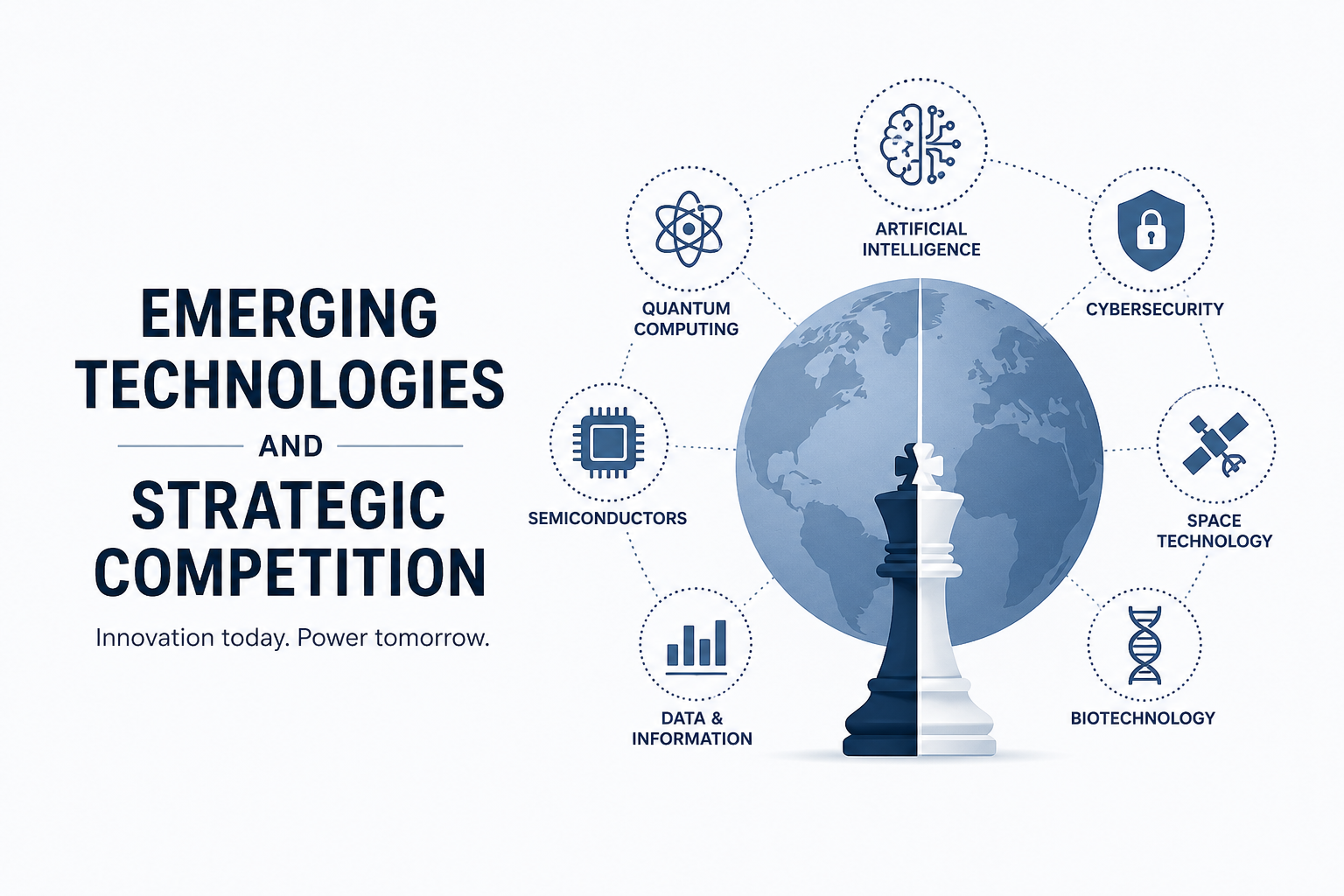
Today, the world is entering another period of technological transformation. Artificial intelligence, quantum computing, advanced semiconductors, biotechnology, robotics, space systems, cybersecurity capabilities, advanced communications networks, and other emerging technologies are reshaping the foundations of economic and geopolitical power. These technologies are not isolated developments. They interact with one another, creating complex ecosystems that influence national competitiveness and international relations.
Governments around the world increasingly recognize that leadership in emerging technologies may determine future economic prosperity, military effectiveness, scientific achievement, and geopolitical influence. As a result, competition for technological leadership has become one of the defining characteristics of contemporary international affairs.
At the same time, emerging technologies present challenges that extend beyond traditional geopolitical rivalries. Their development raises questions regarding governance, ethics, security, resilience, and international cooperation. Many technological challenges are global in nature, requiring collaboration even among competing powers.
The future international order will therefore be shaped not only by who develops the most advanced technologies but also by how societies manage the opportunities and risks that accompany them.
The Technological Foundations of Modern Power
Historically, national power has been measured through factors such as population size, economic output, military capabilities, geographic position, and access to natural resources. While these elements remain important, technology has become increasingly central to the exercise of power.
Modern economies depend on digital infrastructure, advanced manufacturing, scientific research, and innovation ecosystems. Military organizations rely on sophisticated communications systems, precision technologies, data analytics, and cyber capabilities. Governments use technology to deliver public services, manage infrastructure, and support economic development.
As technological systems become more integrated into every aspect of society, innovation itself becomes a strategic asset. Countries that lead in critical technologies often gain advantages that extend across multiple sectors simultaneously.
This transformation has elevated technology from a supporting component of national power to one of its primary foundations.
Artificial Intelligence as a Strategic Technology
Artificial intelligence is perhaps the most influential emerging technology of the current era.
Its applications span healthcare, finance, manufacturing, transportation, education, scientific research, cybersecurity, and defense. AI systems can process vast quantities of information, identify patterns, automate tasks, and support decision-making processes at unprecedented scales.
The strategic significance of AI lies in its versatility. Unlike many technologies that affect a specific sector, AI functions as a general-purpose technology capable of transforming multiple industries simultaneously.
Governments increasingly view AI as a source of economic competitiveness and national security advantage. Countries that successfully develop advanced AI capabilities may enhance productivity, accelerate innovation, improve public services, and strengthen defense systems.
The competition surrounding AI therefore reflects broader efforts to secure leadership in the technologies shaping the future global economy.
Semiconductors and the Infrastructure of Innovation
Advanced semiconductors serve as the foundation upon which much of the modern technological ecosystem depends.
Artificial intelligence systems, cloud computing platforms, telecommunications networks, consumer electronics, military systems, and scientific instruments all rely on increasingly sophisticated chips.
The semiconductor industry occupies a unique position because it supports numerous other technologies. Without access to advanced chips, progress in AI, quantum research, advanced manufacturing, and digital infrastructure becomes significantly more difficult.
This central role has transformed semiconductors into strategic assets. Governments increasingly view semiconductor capabilities as matters of economic security and technological sovereignty.
The global competition surrounding semiconductor production, supply chains, and innovation illustrates how critical infrastructure can influence broader geopolitical dynamics.
Quantum Computing and Scientific Leadership
Quantum computing represents one of the most ambitious technological pursuits of the modern era.
Although practical large-scale quantum systems remain under development, the technology has the potential to transform computing, cryptography, materials science, logistics, pharmaceuticals, and advanced simulations.
The strategic significance of quantum computing extends beyond commercial applications. Countries leading in quantum technologies may gain advantages in scientific research, cybersecurity, and innovation capacity.
The race to develop quantum capabilities highlights the growing importance of long-term scientific investment. Success in this field requires highly specialized expertise, advanced research infrastructure, and sustained commitment.
As a result, quantum computing has become an important indicator of technological sophistication and national innovation capacity.
Biotechnology and Strategic Resilience
Biotechnology has emerged as another critical area of strategic competition.
Advances in genetics, synthetic biology, bioengineering, and medical research have significant implications for healthcare, agriculture, environmental sustainability, and industrial development.
The COVID-19 pandemic demonstrated the strategic importance of scientific capacity and biotechnology infrastructure. Countries with strong research ecosystems were often better positioned to develop medical countermeasures and respond to emerging challenges.
Biotechnology’s growing integration with artificial intelligence further increases its significance. AI-driven research tools are accelerating scientific discovery and enabling new approaches to complex biological problems.
As biotechnology continues to evolve, it is likely to play an increasingly important role in economic development, public health, and national resilience.
Cyber Capabilities and Digital Competition
Cybersecurity has become an essential component of modern strategic competition.
Digital infrastructure supports critical sectors including finance, energy, transportation, healthcare, communications, and government operations. Consequently, cybersecurity vulnerabilities can have far-reaching consequences.
Cyber capabilities influence both defensive resilience and offensive potential. Governments invest heavily in protecting networks, securing infrastructure, and strengthening digital resilience.
At the same time, cyber operations have become important tools within broader geopolitical competition. Information security, intelligence gathering, and digital influence increasingly shape international relations.
The growing importance of cyberspace illustrates how strategic competition now extends far beyond traditional military domains.
Space Technology and the New Frontier
Space has reemerged as an important arena of technological and geopolitical competition.
Satellites support communications, navigation, environmental monitoring, scientific research, and military operations. Launch capabilities, exploration programs, and space-based infrastructure increasingly contribute to national influence and technological prestige.
Unlike the Cold War-era Space Race, the contemporary space environment involves a wider range of participants. Governments, private companies, universities, and international partnerships all play important roles.
The strategic significance of space derives from both practical applications and symbolic value. Leadership in space technologies often reflects broader scientific and industrial capabilities.
As space activities expand, they will continue influencing economic development, national security, and international cooperation.
Data and Information Power
Data has become one of the most valuable resources of the digital age.
Artificial intelligence systems depend on large datasets for training and optimization. Governments use information to support policymaking and public services. Businesses rely on data analytics to improve efficiency and develop new products.
The strategic value of data lies in its ability to generate insights, support innovation, and enable technological development. Countries capable of effectively collecting, managing, and utilizing information may gain significant advantages in economic competitiveness and scientific research.
As digitalization accelerates, data governance becomes increasingly important. Questions regarding ownership, access, privacy, security, and sovereignty are central to contemporary policy debates.
Information power is emerging as a key dimension of national power.
Strategic Competition Beyond Traditional Rivalries
While discussions of strategic competition often focus on major powers, the technological landscape is increasingly multipolar.
Countries such as India, Japan, South Korea, Germany, Singapore, Israel, and others are making significant contributions to technological innovation. Regional technology ecosystems are becoming more influential, and emerging economies are investing heavily in digital infrastructure and scientific capacity.
This broader distribution of technological capabilities creates a more complex international environment. Competition is no longer confined to a small number of dominant actors.
Instead, innovation increasingly emerges from diverse networks involving governments, corporations, universities, startups, and international partnerships.
The future technological order may therefore be characterized by multiple centers of innovation rather than a single dominant power.
The Role of Innovation Ecosystems
Technological leadership depends on more than research spending or industrial capacity.
Successful innovation ecosystems typically combine:
• Strong educational institutions
• Research excellence
• Entrepreneurial culture
• Access to capital
• Skilled talent
• Supportive public policies
• International collaboration
Countries that cultivate these elements often demonstrate greater adaptability and resilience in the face of technological change.
The competition for talent has become particularly important. Scientists, engineers, entrepreneurs, and researchers play critical roles in generating new ideas and translating discoveries into practical applications.
Human capital remains one of the most important determinants of long-term technological competitiveness.
Cooperation in an Era of Competition
Despite growing competition, emerging technologies also create incentives for cooperation.
Scientific research often benefits from international collaboration. Climate change, public health, cybersecurity, and AI safety are challenges that transcend national borders.
International standards facilitate interoperability and support innovation. Academic exchanges contribute to scientific progress. Multilateral institutions provide forums for dialogue and coordination.
The future technological landscape is therefore likely to involve a mixture of competition and cooperation.Managing this balance will be one of the central challenges facing policymakers during the coming decades.
Risks and Governance Challenges
The rapid development of emerging technologies introduces significant governance challenges.
Artificial intelligence raises questions regarding safety, transparency, and accountability. Biotechnology generates ethical concerns and regulatory complexities. Cybersecurity threats continue to evolve. Space activities require sustainable governance frameworks.
Policymakers must balance innovation with risk management. Excessive regulation may slow technological progress, while insufficient oversight may increase vulnerabilities.
Effective governance requires flexibility, international dialogue, and the ability to adapt to rapidly changing technological conditions.
The success of future governance frameworks may significantly influence how societies experience technological transformation.
The Future Global Balance of Power
Emerging technologies are reshaping how power is generated and exercised.
Economic competitiveness increasingly depends on innovation capacity. Military effectiveness relies on advanced technological systems. Scientific leadership influences long-term development opportunities. Digital infrastructure supports critical societal functions.
The future balance of power is therefore likely to be influenced by a country’s ability to develop, adopt, and govern emerging technologies effectively.
However, technological leadership alone is not sufficient. Institutions, education systems, governance quality, economic resilience, and social cohesion will remain important determinants of national success
The countries best positioned for the future may be those capable of integrating technological innovation into broader strategies for sustainable development and international engagement.
Conclusion
Emerging technologies have become one of the most important drivers of strategic competition in the twenty-first century. Artificial intelligence, semiconductors, quantum computing, biotechnology, cybersecurity, space systems, and data infrastructure are transforming economies, security environments, and international relations.
These technologies represent more than scientific achievements. They increasingly shape national power, influence geopolitical dynamics, and affect how societies address complex challenges. As a result, competition for technological leadership has become a defining feature of contemporary global affairs.
Yet the future is unlikely to be determined solely by rivalry. Many of the opportunities and risks associated with emerging technologies require cooperation, coordination, and shared governance approaches. The most successful nations may be those that balance competitiveness with openness, innovation with responsibility, and national interests with international engagement.
The coming decades will reveal how technological transformation influences the global order. What is already clear, however, is that emerging technologies are no longer peripheral to international politics. They have become central to understanding power, prosperity, and security in the modern world.
In this sense, the story of strategic competition in the twenty-first century is ultimately a story about innovation—how it is developed, who controls it, how it is governed, and how it shapes the future of humanity itself.